Cabinet Door Styles
Painted vs Stained vs Natural Cabinets
The three finish families compared: what each shows and hides, the substrate and matching the AWI standard requires, how each ages and is repaired, and what the pricing engine assumes about each.
Quick Answer
Painted, stained or natural — which finish should you choose?
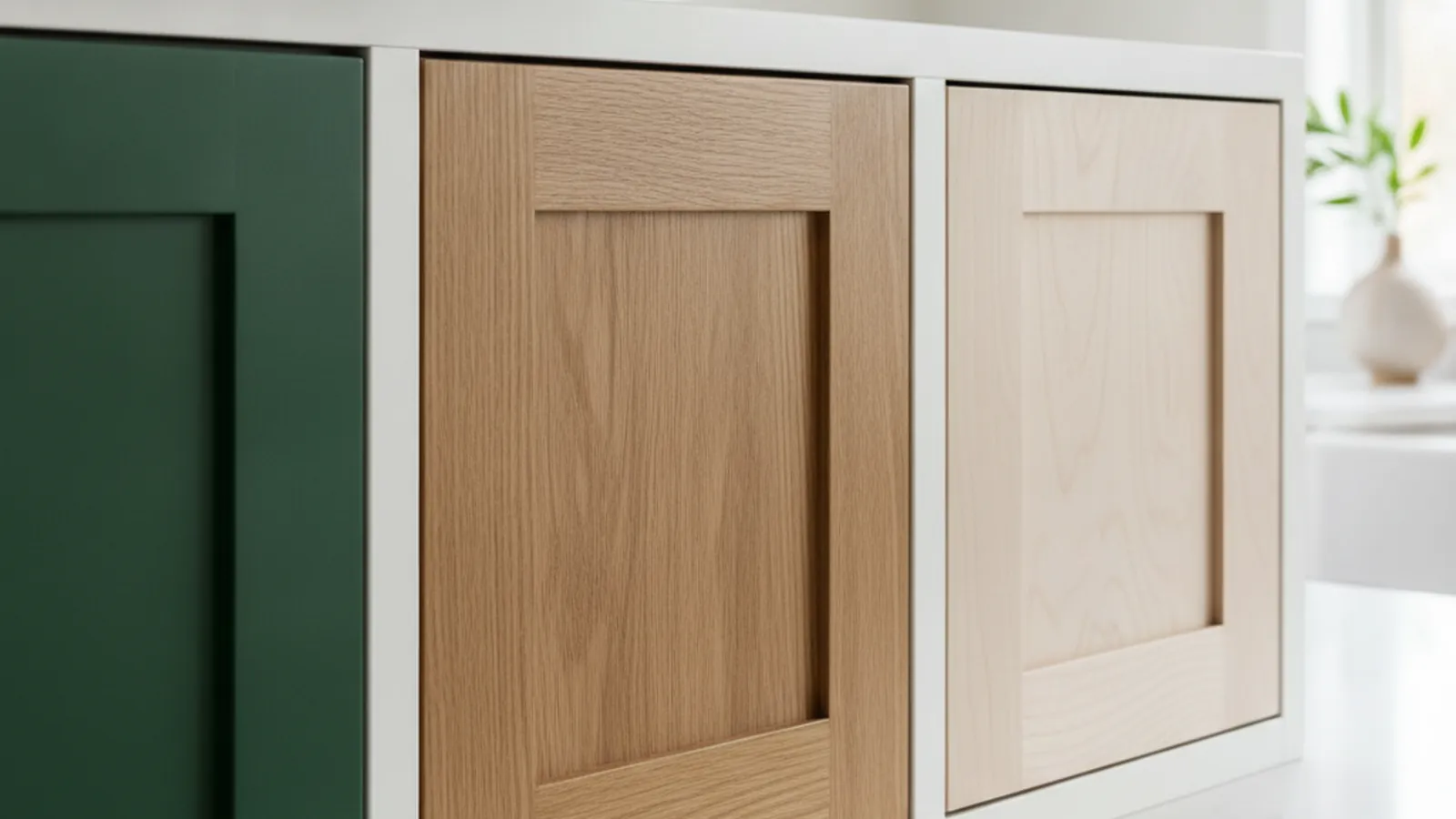
Painted for a kitchen that wants colour, forgives a change of taste and belongs in a postwar or revival house; stained where the house was built with coloured wood and the grain should show; natural where the species itself is the design, as in an Eichler or a glass-walled mountain house.
The AWI standard builds each on different material: MDF or MDO under paint at Premium grade, matched solid stock or Grade AA veneer under a transparent finish. The Wood Handbook says wood changes colour under light whether finished or not, so stained and natural kitchens age and paint does not. The pricing engine assumes ×1.10 natural, ×1.15 painted, ×1.28 stained.
Key Takeaways
- The AWI glossary splits finishes into opaque — paint or pigmented, hiding the grain — and transparent — stain or clear, showing it. Painted is opaque; stained and natural are both transparent.
- ANSI/AWI 0641-2019 requires MDF or MDO under opaque finishes at Premium grade, with edges filled or edgebanded, and matched solid stock or HP-1 Grade AA veneer under transparent finishes, with adjacent panels matched for colour and grain.
- Stain colours earlywood more than latewood and accentuates grain; a wash coat gives uniform colour; blotching comes from the lumber and cannot be fixed after staining. A clear finish accentuates surface blemishes.
- Wood changes colour indoors under visible light, finished or not — dark lightens, light darkens — and a shaded ghost evens out over months. Paint does not change this way, but its film opens as a hairline at every moving joint.
- Touch-up follows the family: colour and sheen on a film for paint, a stain match under clear for stained, and a clear blend for natural, which is easiest to match and slowest to catch up in colour.
- The pricing engine’s finish multipliers are 1.10 natural, 1.15 painted and 1.28 stained — the calculator’s assumptions about finishing-room labour, applied to the base rate and not a quote. Projects start at $25,000.
How Do the Three Finish Families Compare?
Painted, stained and natural on definition, required substrate, what shows, how each ages, how each is repaired, and the calculator’s multiplier.
| Finish | Definition | Substrate the standard requires | What shows | How it ages | Touch-up | Calculator multiplier |
|---|---|---|---|---|---|---|
| Painted (opaque) | A paint or pigmented finish that hides the natural characteristics and colour of the grain, in the AWI glossary’s words. | Premium grade: MDF or MDO on exposed surfaces; Custom adds closed-grain hardwood veneer or solid stock. MDF edges filled or edgebanded. | Colour and sheen only. The species underneath is a construction choice, not a visible one; grain and joints telegraph if the substrate is wrong. | A pigmented film does not change colour with the wood, but it bridges every joint, so a hairline at a panel edge is the first thing to appear. | Colour and sheen match on a film; a pigmented version of the shop chemistry is used, and the repair is blended across a face rather than a spot. | ×1.15 in the pricing engine — the calculator’s assumption. |
| Stained (transparent, coloured) | A finishing step that produces the desired undertone colour while the grain shows through the topcoat — a transparent finish in the glossary. | Premium grade: solid stock well matched for colour and grain, veneer HP-1 Grade AA; adjacent door panels matched for colour and grain. | Grain and figure, with the natural colour shifted. Stain colours earlywood more than latewood, so the grain pattern is accentuated and sometimes reversed. | Both the stain layer and the wood beneath it change with light; the Wood Handbook says dark wood lightens and light wood darkens indoors. | A stain match beneath a clear topcoat, then sheen. Matching a colour that has aged is the harder half of the job. | ×1.28 in the pricing engine — the calculator’s assumption, and the highest of the three. |
| Natural (transparent, clear) | A clear finish with no colour layer: the species, cut and matching are the entire design. | Same transparent-finish requirements as stained: matched solid stock or Grade AA veneer at Premium, same species and cut on exposed interiors. | Everything: colour, grain, figure, sapwood, mineral streak. Transparent finishes also accentuate surface blemishes, so preparation shows. | The wood itself ages — visibly in cherry and walnut — and a shaded area shows as a lighter or darker ghost that evens out over months of exposure. | No colour layer to match, so a clear repair is the easiest to blend; but new wood beside aged wood shows until the light catches it up. | ×1.10 in the pricing engine — the calculator’s assumption, and the lowest. |
What Do Painted, Stained and Natural Actually Mean?
The Architectural Woodwork Institute sorts every cabinet finish into two families, opaque and transparent, and the three choices homeowners talk about fall out of that split.
The AWI glossary defines an opaque finish as a paint or pigmented stain finish that hides the natural characteristics and colour of the grain of the wood surface, and a transparent finish as a stain or a clear finish that allows the natural characteristics and colour of the wood grain to show through the topcoat. Paint is the opaque family. Stained and natural are both transparent; the difference between them is whether a colouring step comes before the clear coats. The glossary describes stain as a finishing step used to produce the desired undertone colour with proper distribution, depth and clarity of grain, usually a water- or oil-based liquid carrying ultrafine pigment particles.
That split matters because the standard writes different material rules for each family, as the next section explains, and because the three choices behave differently over time. A painted kitchen is a coloured film over a substrate chosen for flatness. A stained kitchen is a coloured layer in the wood under a clear film, and both the layer and the wood respond to light. A natural kitchen is the wood alone under a clear film, which makes the species, the cut and the matching the whole design. Our finish systems guide covers the chemistry of the clear and pigmented films themselves; this page is about choosing between the three.
What Does the AWI Standard Require Underneath Each Finish?
The finish decides what the door is made of. ANSI/AWI 0641-2019 specifies the substrate for opaque work and the matching for transparent work, grade by grade.
For opaque finishes, Section 3.4 of the casework standard requires exposed exterior substrates at Premium grade to be MDF or MDO; at Custom grade it adds closed-grain hardwood veneer or solid stock; at Economy grade it permits particleboard, softwood or hardwood veneer or solid stock as well. MDF and MDO edges on opaque doors must be filled or edgebanded, with MDO edgebanded at Premium. The reason is the one our shaker doors spoke gives: a paint film shows every telegraphed grain line and every hairline where a solid panel has shrunk from its frame, and MDF is flat out of the press. A painted door is therefore a hardwood frame around an MDF panel, or a slab in MDF or MDO, by the standard’s own logic.
For transparent finishes the rules are about matching rather than substrate. At Premium grade exposed exterior solid stock must be well matched for colour and grain and veneer must be HP-1 Grade AA; at Custom grade solid stock and veneer must be compatible in colour and grain and veneer Grade A; at Economy grade compatibility in colour is enough. Exposed interiors at Premium must be the same species and cut as the exterior. Door faces at Premium must be vertically matched and sequenced across an elevation, and adjacent door panels under a transparent finish must match for colour and grain at Premium and Custom. Hardboard is not permitted on any exposed transparent surface.
Those two sets of rules explain most of the cost and most of the behaviour. A stained or natural kitchen is a sorting exercise before it is a finishing one: stock selected for colour, panels cut from matched material, doors laid out in sequence on the bench. A painted kitchen skips the sorting and spends its effort on flatness and edges instead. Neither is cheaper to do well; they are expensive in different places.
How Much of the Species Shows Through Each Finish?
Paint shows none of it, stain shows a shifted version of it, and a clear coat shows all of it — including the things a stain would have hidden.
The USDA Forest Products Laboratory’s Wood Handbook describes what a stain does to grain: stains accentuate wood grain by absorbing differently into earlywood, latewood, knots, vessels and flaws, and they colour earlywood more than latewood, reversing the natural colour gradation. For uniform colour the Handbook recommends a penetrating sealer, a wash coat, before staining to impede absorption into the earlywood. It also warns that if stain absorbs unevenly and blotches, the cause is usually in the lumber rather than the finisher, and that the problem cannot be fixed once the stain is applied — which is why a shop tests stock before committing a run of doors to a colour.
A clear finish is less forgiving in a different way. The Handbook notes that transparent film-forming finishes give excellent performance on wood indoors but accentuate surface blemishes, so planer marks and raised grain must be removed before finishing. Under a natural finish the sapwood line, a mineral streak and a colour difference between boards are all design elements, wanted or not, and the matching rules above are what keep them deliberate. Our wood species guide covers how each species reads clear; the short version is that walnut and rift white oak are the species most often finished natural, and alder and cherry most often stained.
Under paint the species is a construction decision. The frame is hardwood because it carries the hinge cups and the groove; the panel is MDF because it stays flat. The Handbook adds a detail that matters for the few painted doors built in solid wood: vessels in most ring-porous hardwoods need to be filled to obtain a smooth finished surface, and for opaque finishes the sequence is fill, sand, primer or sealer, then topcoats. An open-grained oak under paint shows its pores through the film unless that filling is done, which is one more reason the standard points opaque work at MDF.
How Does Each Finish Age, and How Is It Touched Up?
A painted film does not change colour but shows every joint. A transparent finish moves with the wood and the light. Repairs follow the same split.
The Wood Handbook is direct about colour: wood changes colour as it ages indoors, whether unfinished or finished, and in general dark wood gets lighter and light wood gets darker. The cause is visible light, not the ultraviolet that drives exterior weathering, and the Handbook’s example is the shadow a picture leaves on panelling, which evens out within several months once the wood is exposed. In a kitchen the picture is a canister, a cutting board or the shaded face of an island, and under a natural or stained finish that ghost appears, then fades. Under paint it does not appear at all, because the film is the colour.
What appears under paint instead is the joint. A pigmented film bridges the four corners of a stile-and-rail door and the edge of a floating panel, and when the panel moves with the seasons the film at that edge opens as a hairline. Our shaker doors spoke calls it the first thing to appear and the least serious. On a slab in MDF or MDO there is no joint to open, which is why the standard’s substrate rule produces the most durable painted door. The Handbook also notes that interior wood products require less protection against water and ultraviolet than exterior ones and that finishes usually last for decades, but that interior work is held to more exacting standards for appearance and cleanability — and it is appearance, not failure, that sends a kitchen back for touch-up.
Touch-up follows the family. A painted repair is a colour and sheen match on a film; the shop uses a pigmented version of the same chemistry it sprayed — M.L. Campbell, for instance, publishes pigmented and white-base versions of its MagnaMax lacquer and a waterborne white topcoat alongside its clear products — and blends across a face rather than spotting, because a spot of new film reads as a spot. A stained repair is a stain match under a clear coat, and the hard half is matching a colour the light has already changed. A clear repair has no colour layer to match, which makes it the easiest to blend, but the new wood beside aged wood shows until exposure catches it up. The Handbook’s note that oil finishes penetrate without forming a film and are easy to apply and maintain is the case for oil in rooms where touch-up matters more than chemical resistance; our mountain finish systems guide weighs that trade.
What Does Each Finish Do to the Price?
The PineWood pricing engine applies a finish multiplier to the base rate. The figures are the calculator’s assumptions, not quotes, and the order they fall in has a reason.
The engine behind our kitchen cost calculator multiplies the per-linear-foot base rate by a finish factor: 1.10 for natural, 1.15 for painted and 1.28 for stained. Those are the calculator’s assumptions about shop time, and they are applied in sequence with the layout, door style and hardware multipliers that our how custom cabinetry is priced guide explains. They are not a price for any particular kitchen, and the only firm figure is that projects start at $25,000.
The order is the sorting and matching described above. A stained kitchen carries the transparent-finish matching requirements of the standard plus a colouring step that must be tested on the actual stock, sealed against blotching and applied evenly across every face, and it is the most labour of the three in the finishing room. A painted kitchen carries edge filling, priming and a pigmented topcoat on a substrate that needs no sorting. A natural kitchen carries the matching but not the colouring, and so sits lowest in the engine. The engine does not weight the species, so the difference between natural alder and natural walnut is a material cost that lives in the base rate band, not in the multiplier.
The practical use of the multipliers is comparative. Run the same kitchen three times in the calculator, changing only the finish, and the spread between the results is the engine’s view of the finishing-room difference. Everything else — the door family, the box material, the interface — is held constant, which is the honest way to see the finish on its own.
Which Finish Suits Which Northern California Kitchen?
The house, the light and the use decide. The region’s housing waves each had a finish, and the rooms that get the most sun and the hardest wear narrow the choice further.
Painted belongs in the postwar subdivisions and the revival houses: a painted shaker in overlay for a Roseville or Walnut Creek ranch, a painted inset for a Tudor or Colonial Revival kitchen, as our period homes guide describes. It is the finish for a kitchen that will be repainted in a new colour in twenty years rather than refinished, and the one that forgives a change of taste. Stained belongs where the house was built with coloured wood: quartersawn oak in a Craftsman bungalow, cherry in a Colonial Revival dining room, alder in a Tahoe lodge. Natural belongs where the species is the design — walnut and rift white oak in an Eichler, as our finishes for mid-century homes spoke explains, and the same species in a glass-walled mountain house.
Light is the second filter. A natural or stained kitchen under a wall of south glass will show the Handbook’s colour change quickly and unevenly, and the owner should want that patina or choose paint. Use is the third. A ski-week kitchen, a vineyard house that entertains, or a family kitchen with young children tests chemical resistance and abrasion more than colour, and the finish systems guide covers which chemistry answers that. The finish family and the finish chemistry are separate decisions, and this page settles only the first.
Finish Systems
The chemistry under all three families: cure, catalyst, durability ratings and sheen.
Read the Guide →Finishes for Mid-Century Homes
Walnut, rift oak and muted paint beside original Philippine mahogany.
Read the Guide →Finishes for Dry Alpine Interiors
Conversion varnish, waterborne or oil in a heated mountain house.
Read the Guide →Shaker Doors
The painted MDF panel and the stained matched panel, and why the finish decides which.
Read the Guide →Frequently Asked Questions
- What is the difference between a painted, a stained and a natural cabinet finish?
- The AWI glossary defines an opaque finish as a paint or pigmented finish that hides the natural characteristics and colour of the grain, and a transparent finish as a stain or clear finish that lets the grain show through the topcoat. Painted is opaque. Stained and natural are both transparent; stained adds a colouring step before the clear coats and natural does not.
- Why are painted cabinet doors built with MDF panels?
- Because ANSI/AWI 0641-2019 requires exposed opaque-finish substrates at Premium grade to be MDF or MDO, with edges filled or edgebanded, and because a paint film shows every telegraphed grain line and every hairline where a solid panel shrinks from its frame. MDF is flat out of the press and does not move seasonally. The frame stays hardwood to carry the hinge cups.
- Do stained or natural cabinets change colour over time?
- Yes. The Wood Handbook states that wood changes colour as it ages indoors, finished or not, that dark wood generally gets lighter and light wood darker, and that the cause is visible light rather than ultraviolet. A shaded area shows as a ghost that evens out within several months of exposure. A painted film does not change in this way because the film is the colour.
- Which finish is easiest to touch up?
- A natural clear finish, because there is no colour layer to match, though new wood beside aged wood shows until the light catches it up. A painted repair is a colour and sheen match on a film using a pigmented version of the shop chemistry, blended across a face. A stained repair is a stain match under a clear coat, and matching a colour that has already aged is the harder half.
- How much more do stained cabinets cost than painted ones?
- The PineWood pricing engine applies finish multipliers of 1.28 for stained, 1.15 for painted and 1.10 for natural to the per-linear-foot base rate. Those are the calculator’s assumptions about finishing-room labour — the stain carries the standard’s matching requirements plus a colouring step — and not a quote for any kitchen. Projects start at $25,000.
- Which species are usually finished natural, and which are stained?
- Walnut and rift or quartersawn white oak are the species most often finished clear, because their colour and figure are the design. Alder and cherry are most often stained. The Wood Handbook notes that stain colours earlywood more than latewood and accentuates grain, that a wash coat gives uniform colour, and that blotching comes from the lumber and cannot be fixed once the stain is on.
References
- Architectural Woodwork Institute — Glossary (opaque finish, transparent finish, stain, solid stock, veneer)
- Architectural Woodwork Institute — ANSI/AWI 0641-2019 Architectural Wood Casework, Section 3.4 Aesthetic (opaque-finish substrates by grade, MDF and MDO edges, transparent-finish matching, veneer grades, door grain matching, exposed interiors)
- USDA Forest Products Laboratory — Wood Handbook: Wood as an Engineering Material, FPL-GTR-190, Chapter 16 Finishing of Wood (finishing interior wood: colour change with age, stains and wash coats, blotching, fillers for ring-porous hardwoods, transparent finishes, oil finishes)
- M.L. Campbell — Products (clear and pigmented topcoat families: MagnaMax SL Pigmented and White/Opaque Base, Arroyo 1K Waterborne White Topcoat, Krystal conversion varnish, Stains & Glazes)
Explore
Finish, Door and the Rest of the Cabinet
The hub this page belongs to, its sibling door styles, the finish and species guides underneath the decision, the houses each finish suits, and the standards the figures are drawn from.
Finish and Species Underneath
Houses, Services & Related Reading
Continue Reading
Related Guides
More in This Guide
Related Reading
Continue Learning
Planning a kitchen and want to talk it through with the person who will build it?
Request a Design Consultation