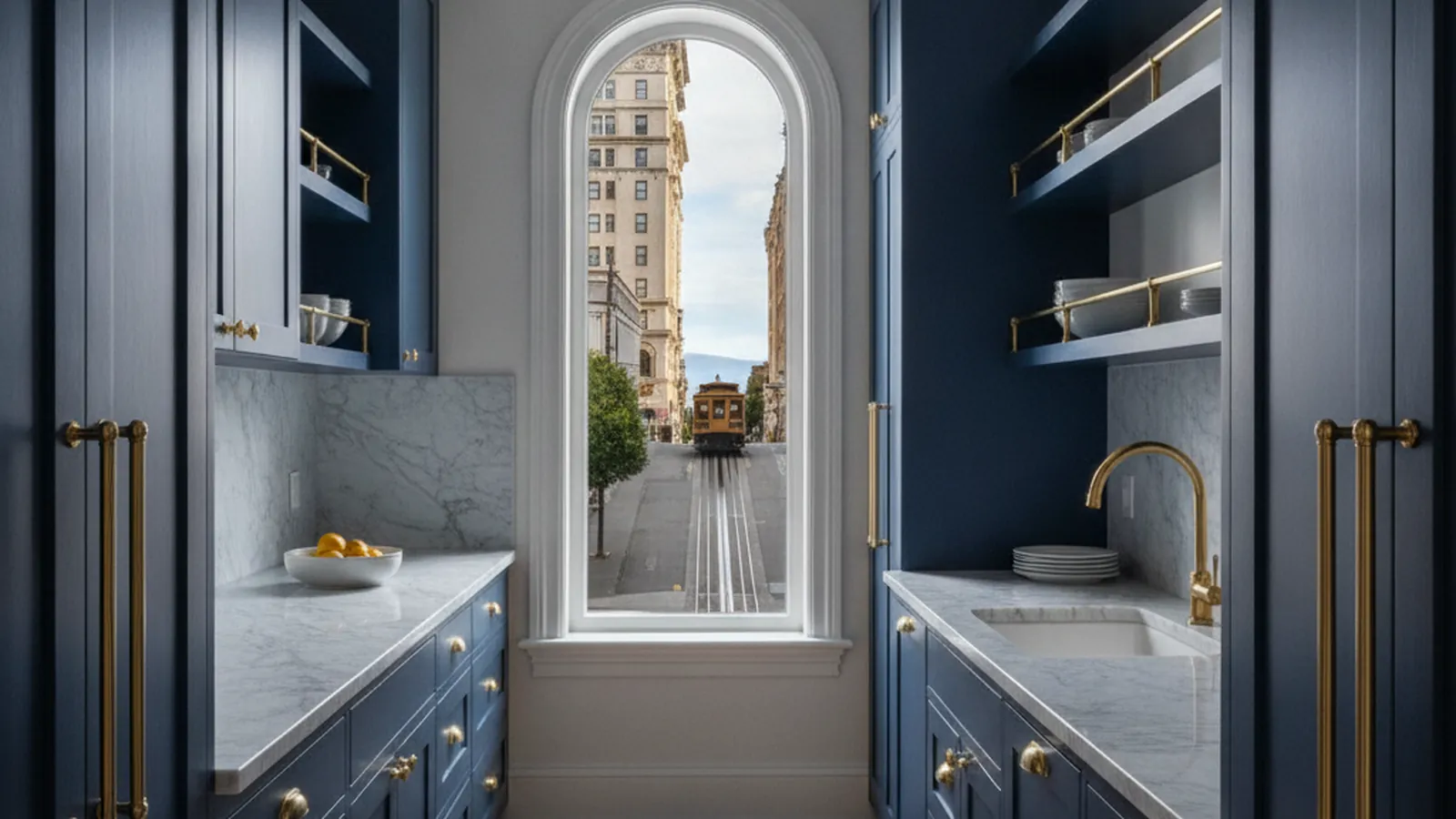
Freight elevators, prewar doorways and galley footprints, measured before we build
Kitchen Remodeling for Nob Hill’s Co-ops, Condos and Flats
Nob Hill is where San Francisco keeps its grandest addresses, perched above the cable car lines that climb California and Powell. Our custom kitchens and cabinetry are built for the neighborhood's prewar apartments, hilltop town homes, and view-line residences, marrying old-world craft with the realities of vertical city living.
- Crafting custom cabinetry since 2006
- Licensed California contractor · CSLB #1095293
- Based in Rocklin, serving San Francisco & the Bay Area
- Design, build & install under one roof
Custom Cabinetry on San Francisco’s Most Storied Hill
Nob Hill rises at the center of San Francisco, the high ground that the railroad and silver fortunes claimed in the 1870s and that has held its prestige ever since. Today the neighborhood is defined less by its lost mansions, most of which burned in 1906, than by the elegant residences that replaced them: the brick and terra-cotta apartment houses along Sacramento, Clay, and Jones streets, the cooperatives that ring Huntington Park, and the landmark hotels, the Fairmont, the Mark Hopkins, and the Stanford Court, that crown the summit at California and Mason. Since 2006, PineWood Cabinets has built custom kitchens and cabinetry for the homeowners who live among them.
The kitchens here tell the story of the buildings that hold them. A 1920s co-op off Pleasant Street may have a galley kitchen tucked behind the formal rooms, original to an era when cooking was hidden from view. A renovated full-floor residence near Taylor and Washington may want an open plan that captures the light and the rooftops falling away toward the Bay. Cathedral Hill flats, the Brocklebank and the Comstock towers, and the quieter blocks sloping toward Polk Gulch each present their own proportions, their own ceiling heights, and their own constraints on how cabinetry can be delivered up an elevator and through a prewar doorway.
Our Nob Hill clients are longtime San Franciscans, building professionals, and people drawn to the neighborhood for its walkability and its address. Grace Cathedral and the bocce-and-bench calm of Huntington Park sit at the top of the hill, the cable cars rattle past the doorstep, and Polk Street’s restaurants and Chinatown’s markets are a short walk downhill. These are homeowners who cook for the pleasure of it and who expect a kitchen as considered as the building it sits inside.
Working in a dense, vertical neighborhood is its own discipline. We plan for the logistics of historic buildings and HOA-governed towers from the first measurement: how cabinetry will move through the lobby and freight elevator, how a renovation respects shared walls and quiet hours, and how a compact footprint can be made to feel generous without sacrificing the character that drew the owner here in the first place.

Why Nob Hill Asks More of a Kitchen
A kitchen on Nob Hill is almost never built on a blank slate. It lives inside architecture with a point of view, prewar plaster and crown moldings, Art Deco detailing, the formal sequence of rooms that defined apartment living a century ago. Our approach begins with that inheritance. We design cabinetry that reads as if it belongs to the building, drawing on the millwork vocabulary already present in the entry hall and the dining room rather than imposing a style the home would never have chosen for itself.
The neighborhood’s great constraint is also its great opportunity: space. Ceilings on Nob Hill tend to run high, so we build vertically, full-height cabinetry, glass-front uppers that carry the eye toward the cornice, and concealed storage that keeps the counters clear and the views uninterrupted. In the smaller galley and one-wall kitchens of the older co-ops, every inch is planned, with pull-out pantries, appliance garages, and custom inserts that make a modest footprint cook like a far larger room.
Material choices answer to the light and the address. North-facing flats want warmer woods and reflective surfaces; sun-struck top floors can carry deeper tones and natural stone. Throughout, we favor honest materials and hand-finished surfaces over anything that reads as builder-grade, because in a neighborhood this discerning, the difference is always noticed.
What Nob Hill Projects Require
- Full-height cabinetry that takes advantage of prewar ceiling heights
- Space-maximizing layouts for galley and one-wall co-op kitchens
- Millwork detailing that echoes original plaster and moldings
- Delivery and installation planned for elevators and historic doorways
- HOA-aware scheduling that respects shared walls and quiet hours
- View-conscious layouts that keep sightlines toward the Bay and city open
From Prewar Co-ops to Hilltop Town Homes
Nob Hill’s housing runs from white-glove apartment towers to the Victorian and Edwardian survivors on its quieter slopes. Each calls for a different hand.
The Apartment and Co-op Kitchen
The classic Nob Hill residence is a unit in a 1910s-to-1930s apartment building, the kind with a manned lobby, a freight elevator, and floor plans drawn for an era of formal entertaining and back-of-house cooking. Renovating these kitchens is as much about logistics and diplomacy as design: cabinetry must be sized to fit the elevator, work must be coordinated with the building’s management and neighbors, and the scope has to respect the limits of a unit you own within a structure you share.
We design these kitchens to open up where they can, borrowing from an adjacent butler’s pantry or breakfast room, and to work harder where they cannot, with custom storage that turns a tight galley into a serious cooking space. The goal is a kitchen that feels modern and effortless yet still belongs to the building’s era.
The Hilltop Town Home Kitchen
Along the edges of the neighborhood, where Nob Hill slopes toward Polk Gulch and the cable car line on Hyde, single-family town homes and converted flats offer more room to reimagine. Here a kitchen renovation can claim a full floor, connect to a rear garden or roof deck, and pursue an open plan that the apartment towers rarely allow.
For these homes we design generous islands, full pantry walls, and cabinetry that flows into adjoining living space, while keeping the proportions and detailing true to the home’s period. The result is a kitchen that lives like new construction without erasing the character that makes a San Francisco town home worth owning.
Areas We Serve Around Nob Hill
From the cooperatives crowning the summit to the slopes that fall toward the surrounding San Francisco neighborhoods, we design and build for homes across the hill and its edges.
Lower Nob Hill
Denser apartment blocks sloping down toward the city
The Cable-Car Corridor
Residences along the California and Powell lines
Huntington Park Area
Cooperatives and flats ringing the hilltop park
Grace Cathedral Area
Quiet blocks near the cathedral at the summit
Polk Gulch-Adjacent
Slopes toward Polk Street’s shops and restaurants
Russian Hill-Adjacent
Where the hill meets the Hyde Street cable line
Chinatown-Adjacent
Lower eastern edge above the Chinatown markets
Union Square-Adjacent
Downhill toward the shopping and theater district
Pacific Heights-Adjacent
Western blocks reaching toward Pacific Heights

Styles That Suit Nob Hill Homes
Nob Hill is a neighborhood of prewar luxury co-op and condo residences set inside historic brick and terra-cotta towers, and the cabinetry that belongs there has to answer that architecture. We work across an elegant range, from warm stained hardwoods and inset doors that echo a building's original millwork to refined painted Shaker and contemporary fronts for renovated full-floor residences, always reading the home's era before drawing a single cabinet.
Because every cabinet is built to order, the proportions follow the room rather than a stock module: full-height storage for high prewar ceilings, glass-front uppers that carry the eye toward the cornice, and tailored inserts that make a compact galley cook like a far larger kitchen. The species, the door profile, the finish, and the hardware stay yours to choose.
Working in a tower also means planning the practical side, building and HOA approvals, freight-elevator dimensions, and access through historic doorways, from the very first measurement. Browse our portfolio to see the range of work, or get in touch to talk through your Nob Hill project.
Nob Hill Kitchen & Cabinetry FAQs
Common questions from Nob Hill homeowners planning a custom kitchen or cabinetry project.
Which parts of Nob Hill and nearby San Francisco do you serve?
We work throughout Nob Hill, from the apartment houses and cooperatives ringing Huntington Park and Grace Cathedral at the summit to Lower Nob Hill, the residences along the California and Powell cable-car lines, and the slopes that fall toward Polk Gulch, Russian Hill, Chinatown, Union Square, and Pacific Heights. We design, build, and install for homes across these surrounding San Francisco blocks as well.
Are you licensed to do kitchen and cabinetry work in San Francisco?
Yes. PineWood Cabinets is a licensed California contractor (CSLB License #1095293) operating as a division of Voronenko & Ethen Associates, and we have designed, built, and installed custom cabinetry since 2006. Our shop is based in Rocklin and we serve San Francisco and the wider Bay Area.
Do you handle design, building, and installation, or just one part?
All of it. We are a full-service design-build cabinetry shop, so the same team that measures your Nob Hill kitchen designs it, builds the cabinetry, and installs it. You are not handed off between a designer, a separate cabinet vendor, and an installer, which keeps a complex city project coordinated from first drawing to final install.
Can you work with prewar co-op and condo kitchens on Nob Hill?
Yes. Many Nob Hill residences are units in 1910s-to-1930s apartment buildings and cooperatives, often with compact galley or one-wall kitchens and high prewar ceilings. We build cabinetry to measure for those spaces, drawing on the millwork detailing already present in the home and planning vertically to make a modest footprint cook like a larger room.
How do you handle building access, HOA rules, and elevator logistics?
We plan the logistics of historic buildings and HOA-governed towers from the first measurement. That means sizing cabinetry to fit a freight elevator and prewar doorways, coordinating with building management and neighbors, working within quiet hours, and protecting shared lobbies, walls, and common areas throughout the project.
How long does a custom Nob Hill kitchen take from design to installation?
It varies with scope, but a custom kitchen is a multi-month process, because the cabinetry is built specifically for your room rather than pulled from stock, and city buildings add coordination around access and HOA approvals. We give you a realistic timeline at the start, after we have measured the space and agreed on the design.
Why Nob Hill Homeowners Work With PineWood Cabinets
In a neighborhood built on attention to detail, our craftsmanship and our handling of complex city projects are made to match.
Built for the City
Logistics First: We plan elevator access, lobby protection, and delivery routes before a single cabinet is built, so a renovation in a historic tower runs without surprises.
Respectful of the Building: We coordinate with HOAs and building management, work within quiet hours, and protect shared walls and common areas throughout the project.
Made to Fit: Every cabinet is custom, which matters most in a neighborhood where no two prewar kitchens share the same dimensions, angles, or quirks.
A Single Craftsman’s Standard
Period Fluency: We read the building’s original detailing and design cabinetry that belongs to it, rather than fighting against the architecture you bought.
Material Integrity: Hand-selected woods, honest joinery, and hand-finished surfaces, the qualities a discerning Nob Hill owner will notice every day.
One Point of Contact: Design through installation under one roof, so the kitchen that arrives is the kitchen that was promised.
From the apartment houses along Sacramento Street to the town homes sloping toward Polk, PineWood Cabinets is the custom-cabinetry choice for Nob Hill homeowners who want their kitchen to live up to the address.
Start Your Nob Hill ProjectNearby Areas We Serve
Signature Services
Trusted resources: National Kitchen & Bath Association · Architectural Woodwork Institute · CA Contractors State License Board

Let’s Begin
Ready to Reimagine Your Nob Hill Kitchen?
Let us design a custom kitchen built for your building’s character and the realities of city living, from prewar co-op to hilltop town home.