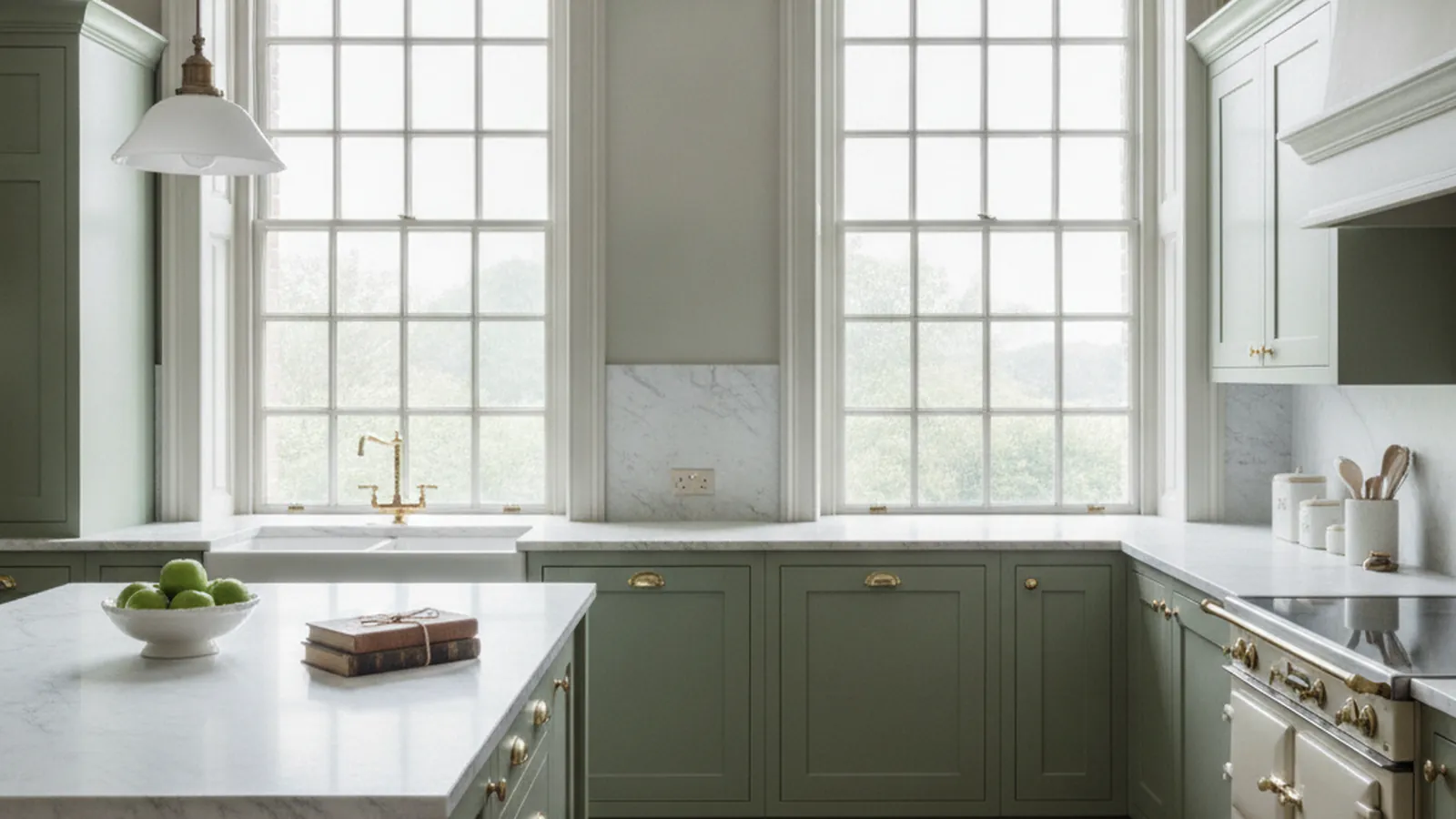
Kitchens for Period Homes
Historic District Review
What San Francisco, Palo Alto, Nevada City, and Sacramento actually review in a historic district, what the National Register and the Mills Act do and do not require, and where a kitchen sits in all of it.
Quick Answer
Does historic district review apply to kitchen cabinetry?
Usually not. Historic review in San Francisco, Palo Alto, and Nevada City attaches to exterior work visible from the public right-of-way: facades, windows, doors, roofs, signs, and demolition. San Francisco exempts interior alterations under Section 1005(e), Palo Alto says interior work typically needs no review, and Nevada City lets staff sign off interior remodels that leave the exterior alone.
The exceptions are narrow and knowable in advance: a kitchen that moves a window or rear door, a publicly owned landmark with a designated interior, or a Mills Act contract whose terms reach inside. National Register listing by itself places no restrictions on a private owner.
Key Takeaways
- Every ordinance cited here regulates exterior appearance within public view. San Francisco Preservation Bulletin No. 4 lists interior alterations as exempt from a Certificate of Appropriateness under Section 1005(e), except for publicly owned landmarks whose designating ordinance covers the interior.
- Palo Alto states that interior work and landscaping for historic resources typically do not require historic review if no changes are made to the exterior appearance of the building.
- Nevada City’s Ordinance 338 (August 1968) requires permits for demolition, exterior alteration, and signs in the Historical District; the city’s Design Guidelines allow staff to sign off interior remodels that do not make major exterior changes such as window or door treatments.
- National Register listing places no restrictions on what a non-federal owner may do with their property unless federal assistance is involved; state and local laws are what bind an owner.
- A Mills Act contract is a ten-year, yearly-renewing agreement administered by the local government, and its preservation terms are specific to the contract — read it before planning interior work.
What Does Historic District Review Actually Cover?
The pattern across Northern California jurisdictions is consistent: review attaches to the parts of a building the public can see, not to the rooms inside it.
A historic district exists to protect a streetscape. Every ordinance we read for this guide says so in its own words. Nevada City’s Ordinance 338 regulates buildings “as to their exterior appearance within public view.” San Francisco’s Certificate of Appropriateness is required for exterior alterations to landmarks that need a permit and, in historic districts, for “other types of exterior changes visible from a public street or other public places.” Palo Alto’s project-review page describes the trigger as “many exterior projects.” The common thread is that the regulated object is the facade, the roof, the windows, the signs, and the massing a neighbor or a passer-by experiences.
That matters for a kitchen because cabinetry is interior work. A new run of inset cabinets, a built-in hutch, or a pantry wall changes nothing the ordinance was written to protect. The exceptions exist, and this guide names them, but they are narrow: publicly owned landmarks whose designating ordinance specifically covers the interior, kitchens whose remodel also moves a window or a rear door, and properties under a Mills Act contract whose preservation terms were negotiated individually. A homeowner who confirms the designation status of the house before design begins will know which, if any, of those apply.
The second thing the review bodies have in common is that they are local. The National Park Service is explicit that Register listing “places no restrictions on what a non-federal owner may do with their property,” and the Office of Historic Preservation states that the Mills Act is “administered and implemented by local governments.” The office that decides whether a kitchen needs anything beyond a building permit is the city planning department, and the answer depends on which list, if any, the property is on.
| Framework | What triggers review | Interior cabinetry | Who reviews | Source |
|---|---|---|---|---|
| San Francisco (Article 10 landmarks and historic districts) | Exterior alterations requiring a permit, demolitions, and in districts other exterior changes visible from a public street. Some districts, such as Jackson Square, review work that needs no permit. | Exempt under Section 1005(e), except publicly owned landmarks whose designating ordinance covers the interior. | Historic Preservation Commission; staff for administrative certificates. | SF Planning, Preservation Bulletins 4 and 12 |
| Palo Alto (Professorville and the other listed districts) | Many exterior projects on listed, eligible, or district properties. | Interior work typically needs no historic review if the exterior appearance does not change. | Planning and Development Services; Historic Resources Board. | City of Palo Alto, Historic Preservation Project Review |
| Nevada City (Historical District, Ordinance 338) | Demolition, new construction, any change to exterior appearance, and signs; exterior within public view must substantially conform to the Mother Lode type of architecture. | Staff can sign off interior remodels inside or outside the district that do not make major exterior changes such as window or door treatments. | Planning Commission sitting as the Architectural Review Committee; staff for minor applications. | Ordinance 338; Nevada City Design Guidelines (2015 revision) |
| National Register listing (any of the above, if also federally listed) | Nothing by itself for a private owner, unless the project receives federal assistance. | No federal restriction; state and local rules still apply. | National Park Service lists; State Historic Preservation Office advises. | NPS National Register FAQs |
How Does San Francisco’s Article 10 Treat Interior Work?
Article 10 of the Planning Code establishes individual City Landmarks and Landmark Districts, and its Certificate of Appropriateness is the approval those properties need before exterior work.
San Francisco Planning describes Article 10 as creating two kinds of recognition: individual City Landmarks and Landmark Districts, groups of related historic resources. Article 11 separately governs the Conservation Districts, mostly downtown, through the Major and Minor Permit to Alter. The Historic Preservation Commission reviews changes to designated landmarks and districts and recommends designations to the Board of Supervisors, where designation requires Board action and the Mayor’s signature.
Preservation Bulletin No. 4 sets out what the Certificate of Appropriateness is for. For designated landmarks it is required for “exterior alterations requiring a permit and demolitions of a site or structure.” For historic districts it is required for “alterations requiring a permit and other types of exterior changes visible from a public street or other public places,” and each district’s appendix to Article 10 can add provisions; the bulletin gives Jackson Square as a district where even painting and landscaping, which need no permit, require a certificate. The bulletin also lists four exemptions under Section 1005(e), and the second is the one that governs a kitchen: interior alterations are exempt, “except for publicly-owned landmarks for which the designating ordinance requires review of interior work.” Ordinary maintenance and repair in kind is the third exemption.
Preservation Bulletin No. 12 shows how narrow the interior exception is. The interiors designated under Article 10 as of that bulletin are publicly owned buildings — City Hall, Coit Tower, the Beach Chalet, Carnegie branch libraries, the Rincon Annex — plus the Garden Court of the Palace Hotel. Private residences do not appear. San Francisco Planning’s designated-landmarks page notes a 2023 amendment extending the Castro Theatre designation to its interior, which confirms the same point from the other direction: interior protection in San Francisco is added deliberately, by ordinance, to specific civic and commercial buildings. A Victorian flat in a landmark district has an exterior that is reviewed and a kitchen that is not.
Two cautions. Bulletin No. 4 was adopted in 1998 and names the Landmarks Preservation Advisory Board, since succeeded by the Historic Preservation Commission, so the current code text should be confirmed with Planning for a specific address. And the bulletin is clear that National Register status alone does not trigger a certificate in San Francisco: buildings on the National Register, or rated Architecturally Significant in the 1976 survey, do not require one unless they are also City Landmarks or within City Historic Districts.
What Does Professorville Review Mean for a Kitchen?
Palo Alto’s historic program dates from 1979 and covers four National Register districts; its own project-review page says interior work typically needs no historic review.
The City of Palo Alto states that its Historic Preservation Program began in 1979 and that the city contains four historic districts listed in the National Register. Professorville and the Ramona Street Architectural District are also listed in the Palo Alto Historic Inventory, and the city notes a locally designated extension to the Professorville district that is not federally listed. Green Gables and Greenmeadow, both Eichler tracts, are the other two districts the city names, which is a reminder that “historic” in Palo Alto spans 1890s Craftsman and Shingle houses and 1950s post-and-beam alike.
The city’s Historic Preservation Project Review page is the operative document for a homeowner. It says properties within local and national historic districts, along with listed properties and those deemed eligible for the California or National Register, “require review for many exterior projects.” It then states the rule that matters here: “interior work and landscaping for historic resources typically do not require historic review if no changes are made to the exterior appearance of the building,” and that normal maintenance or repair does not typically require review either. Discretionary applications, such as Architectural Review and variances, are subject to CEQA, and the city cites its Historic Preservation Ordinance, Municipal Code Chapter 16.49, as the basis for review.
For a Professorville kitchen that means the cabinetry, the hutch, and the pantry are outside historic review so long as the windows, doors, and exterior walls stay where they are. The moment a remodel relocates a rear door, enlarges the window over the sink, or adds a bump-out, the project has an exterior component and enters the review the city describes. The design consequence is to decide early whether the kitchen can be solved inside the existing envelope; in a bungalow footprint it often can, which is the subject of the Craftsman bungalow spoke.
How Does Nevada City’s Historical District Ordinance Work?
Ordinance 338, adopted in August 1968, is one of the older local preservation ordinances in California, and its scope is stated plainly: exterior appearance within public view.
Ordinance No. 338, titled “An Ordinance of the City of Nevada City Establishing an Historical District and Providing Regulations for the Protection, Enhancement and Perpetuation of Buildings Therein,” declares the downtown a district “of great historical interest and esthetic value,” symbolic of the city’s past as a Gold Rush mining town. It names the buildings that define that character — the National Hotel, the Nevada Theatre, Firehouse No. 1, Ott’s Assay Office, the Methodist Church on Broad Street among them — and it defines the “Mother Lode type of architecture” as the architecture generally used in the Mother Lode region between 1849 and 1900.
Section 4 requires a permit to demolish or remove any building within the district, to construct any building or “alter any building as to its exterior appearance,” or to place a sign. Section 6 requires that buildings constructed or altered as to their exterior appearance, fronting the streets or alleys within or bounding the district, “shall as to their exterior appearance within public view substantially conform with the Mother Lode type of architecture.” Section 5 protects buildings of special historical interest from demolition unless they are damaged beyond reasonable repair. The ordinance does not regulate interiors; the word does not appear in its operative sections.
The city’s Design Guidelines, originally adopted in 1995 and revised by the City Council in 2015, describe how the ordinance is administered today. The Planning Commission sits as the Architectural Review Committee for exterior alterations within the Historical District, reviewing signage, alterations and additions, new buildings, window replacement, color changes, and roof replacement. Staff can approve a short list of projects, and the guidelines state the one that concerns cabinetry directly: “Staff can sign off on interior remodels (inside or outside the Historical District) that do not affect major changes to the exterior of the home/building such as window or door treatments.” The guidelines also note that Nevada City has no building department of its own and contracts with the Nevada County Building Department, which issues permits after two city staff members sign off on the plans, and that the city can recommend use of the State Historic Building Code to the county building official.
Where Do Sacramento, the National Register, and the Mills Act Fit?
Three more lists come up in conversations about East Sacramento, Land Park, and foothill Victorians, and each has a different effect on a kitchen.
The City of Sacramento maintains the Sacramento Register of Historic and Cultural Resources through its Community Development Department, with a Preservation Director and a Preservation Commission. The city’s 2007 Historic Properties Directory lists the adopted historic districts, concentrated in the central city: Boulevard Park, Poverty Ridge, Bungalow Row, the Alkali Flat districts, Capitol Mansions, Winn Park, and others. East Sacramento’s Fabulous Forties is not among them. That does not mean no East Sacramento property is designated — individual landmarks and contributing resources exist outside the districts — so ask the Preservation Director about a specific address rather than assume either way.
The National Register of Historic Places is, in the National Park Service’s words, “the official list of the Nation’s historic places worthy of preservation,” authorized by the National Historic Preservation Act of 1966 and administered by the Park Service, with more than 100,000 listings as of mid-2025. Its FAQ answers the question homeowners actually ask: listing “places no restrictions on what a non-federal owner may do with their property,” unless the property is involved in a project that receives federal assistance, in which case the Advisory Council on Historic Preservation must be given the opportunity to comment. The FAQ adds that state or local preservation laws may still apply and recommends contacting the State Historic Preservation Office before acting.
The Mills Act is where a kitchen can meet a contractual obligation. The California Office of Historic Preservation describes it as an economic incentive enacted in 1972 that lets participating cities and counties contract with owners of qualified historic properties, who agree to restore, maintain, and protect the property in exchange for property tax relief. Contracts run ten years initially with automatic yearly extensions, transfer to later owners, and are subject to periodic inspection, with each local government setting its own eligibility rules. San Francisco notes that owners of Article 10 landmarks and contributing buildings may be eligible. Because the preservation terms are written into each contract, an owner of a Mills Act property should read the contract before planning interior work; most are concerned with the exterior and with character-defining features, but the document itself governs.
What Do the Secretary of the Interior’s Standards Ask of a Kitchen?
Even where no review applies, the federal Standards for Rehabilitation are a useful discipline for deciding what to keep in a period kitchen.
The National Park Service defines rehabilitation as “the act or process of making possible a compatible use for a property through repair, alterations, and additions” while preserving the features that convey its historical, cultural, or architectural values. The ten Standards for Rehabilitation are written for reviewed projects, but several of them translate directly into cabinetry decisions. Standard 2 asks that the historic character be retained and that distinctive materials and the features and spaces that characterize a property not be removed. Standard 5 asks that distinctive materials, finishes, construction techniques, and examples of craftsmanship be preserved. Standard 6 asks that deteriorated features be repaired rather than replaced, and that a replacement match the old in design, color, texture, and where possible materials.
Two more are the ones a cabinetmaker thinks about most. Standard 3 warns against adding conjectural features or elements from other buildings that create a false sense of historical development; in a kitchen that is the difference between matching the house’s own casing profile and importing a catalogue “Victorian” moulding the house never had. Standard 9 allows new work but asks that it be differentiated from the old and compatible in size, scale, proportion, massing, and materials. A new inset run that takes its stile width and reveal from the original pantry but is plainly new construction satisfies both halves of that sentence. The matching-millwork spoke of this guide works through how that is done at the bench.
Frequently Asked Questions
- Does a kitchen remodel in a San Francisco landmark district need a Certificate of Appropriateness?
- Not for the cabinetry. Preservation Bulletin No. 4 lists interior alterations as exempt under Planning Code Section 1005(e), except for publicly owned landmarks whose designating ordinance requires interior review. A certificate is required for exterior alterations that need a permit and, in districts, for exterior changes visible from a public street, so a kitchen that moves a window or rear door does have a reviewed component.
- Is interior work reviewed in Palo Alto’s Professorville district?
- The City of Palo Alto’s project-review page states that interior work and landscaping for historic resources typically do not require historic review if no changes are made to the exterior appearance of the building. Many exterior projects on district, listed, or eligible properties do require review under Municipal Code Chapter 16.49.
- What does Nevada City’s Historical District ordinance regulate?
- Ordinance 338, adopted in August 1968, requires a permit to demolish, construct, alter the exterior appearance of, or place a sign on any building in the district, and requires exterior appearance within public view to substantially conform to the Mother Lode type of architecture. The city’s Design Guidelines allow staff to sign off interior remodels that do not make major exterior changes such as window or door treatments.
- Does National Register listing restrict what I can do inside my house?
- No. The National Park Service FAQ states that listing places no restrictions on what a non-federal owner may do with their property unless the project receives federal assistance. State and local preservation laws can still apply, which is why the local planning department, not the Register, decides whether review is needed.
- How does a Mills Act contract affect a kitchen project?
- A Mills Act contract is a ten-year agreement, renewing yearly, in which the owner agrees to restore, maintain, and protect the property in exchange for property tax relief; it is administered by the local government and subject to periodic inspection. The preservation terms are written into each contract, so the contract itself should be read before interior work is planned.
- Is the Fabulous Forties a designated historic district?
- East Sacramento’s Fabulous Forties does not appear among the historic districts listed in the City of Sacramento’s 2007 Historic Properties Directory, which concentrates on central-city districts such as Boulevard Park, Poverty Ridge, and Bungalow Row. Individual properties can still be listed as landmarks or contributing resources, so the Preservation Director should be asked about a specific address.
References
- San Francisco Planning — Historic Preservation (Article 10 landmarks and districts, Article 11, Historic Preservation Commission)
- San Francisco Planning — Designated Landmarks and Historic Districts
- San Francisco Planning — Preservation Bulletin No. 4, Certificate of Appropriateness Procedures (PDF, 1998)
- San Francisco Planning — Preservation Bulletin No. 12, Interior Designations Pursuant to Article 10 (PDF, 2003)
- City of Palo Alto — Historic Preservation
- City of Palo Alto — Historic Districts
- City of Palo Alto — Historic Preservation Project Review
- City of Nevada City — Historic Preservation Planning (Ordinance 338 history, Design Guidelines, district map)
- City of Nevada City — Design Guidelines, adopted 1995, revised August 2015 (PDF)
- Nevada City Ordinance No. 338, Historical District (PDF, hosted by Nevada County)
- City of Sacramento — Historic Preservation
- City of Sacramento — Historic Properties Directory, Sacramento Register (PDF, 2007)
- National Park Service — What is the National Register of Historic Places?
- National Park Service — National Register Frequently Asked Questions
- National Park Service — Secretary of the Interior’s Standards for Rehabilitation
- California Office of Historic Preservation — Mills Act Program
Explore
Period Homes, Jurisdiction by Jurisdiction
The review rules above decide what a project must file; the design spokes below decide what the kitchen should be. The service-area pages carry the local permit offices.
In This Guide
Where These Rules Apply
Continue Reading
Related Guides
More in This Guide
Related Reading
Continue Learning
Planning a kitchen and want to talk it through with the person who will build it?
Request a Design Consultation