Cost and Planning
Custom vs Semi-Custom vs Stock Cabinets
What each tier actually delivers — how it is sized, what it is made of, how far it will go on species, finish and interface, which standard stands behind it — and the per-linear-foot bands the pricing engine assigns to each.
Quick Answer
Custom, semi-custom or stock — what do you actually get at each tier?
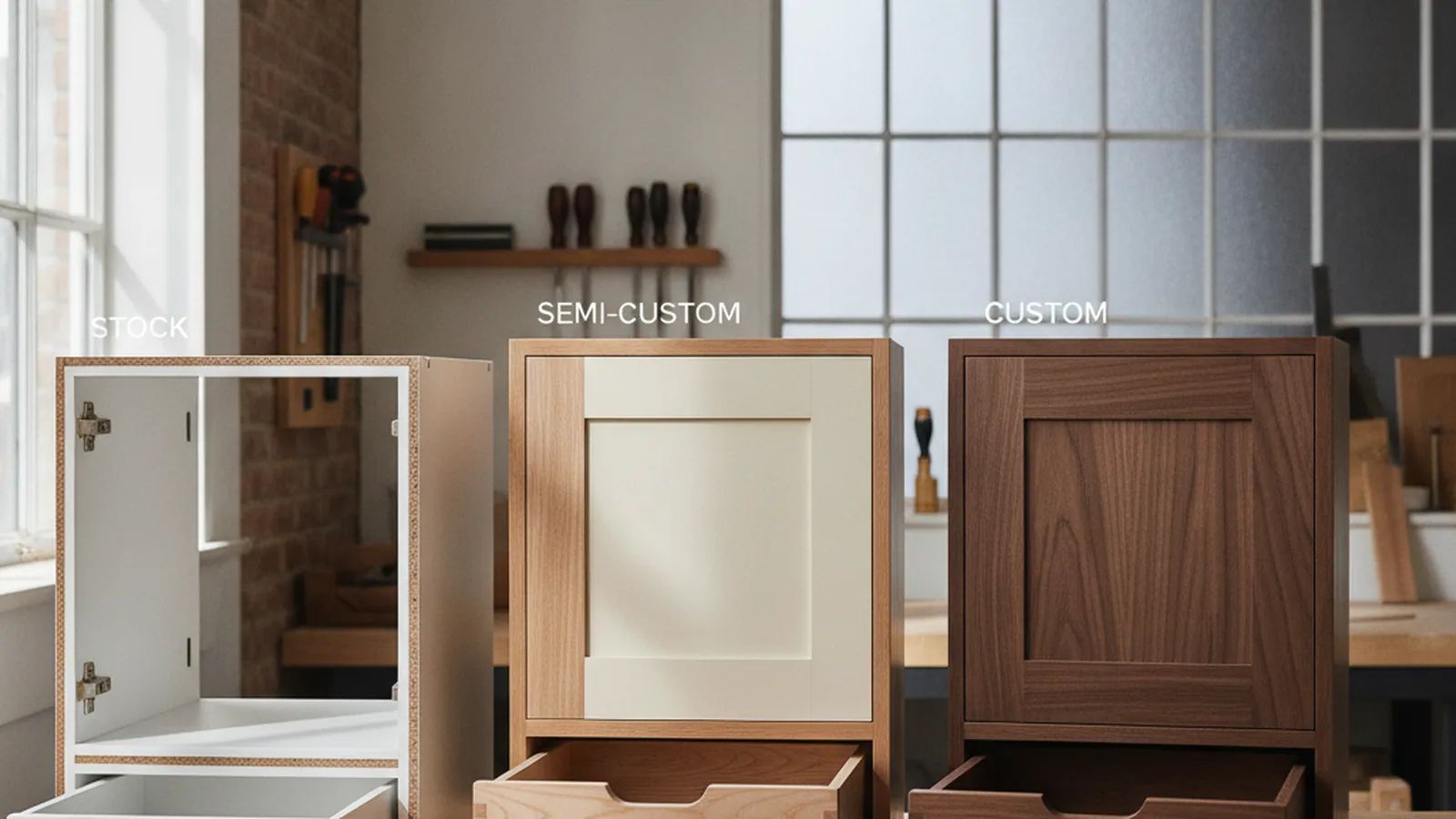
Stock is built ahead of the order in fixed sizes and assembled from the nearest ones; semi-custom is built to order from a catalogue with permitted modifications; custom is drawn for the room and every box and front is sized to its opening. The tiers differ in fit, latitude and who is accountable, more than in strength.
The PineWood pricing engine puts stock at $400 – $880 per linear foot by box material, semi-custom at $650 – $1,450 and custom at $1,200 – $2,600, before multipliers. KCMA certification is a tested floor under a manufactured line at any price point; a custom shop builds to a named AWI grade instead. PineWood builds custom only, from $25,000.
Key Takeaways
- The three tiers are three ways of sizing a cabinet: before the order, from a catalogue with changes, or from the room. No standard defines the words; the AWI uses “Custom” for an aesthetic grade, which applies by default when none is specified.
- The pricing engine’s per-linear-foot bands run from $400 – $520 for stock MDF to $2,000 – $2,600 for custom solid wood. Box material matters almost as much as tier: stock solid wood overlaps semi-custom MDF.
- The step from semi-custom to custom is the largest in the engine in every material. It buys fit to the room, any species and matching sequence, any interface including inset, and a named AWI grade.
- KCMA A161.1 certification tests structure, drawers, doors and finish — fourteen tests including a 600-pound load — and 40 to 50 percent of cabinets fail their first attempt. It is a floor under a manufactured line and says nothing about fit.
- A custom shop does not carry the KCMA seal because the programme certifies production lines; it offers the AWI casework standard’s published tolerances and an open workshop door instead.
- Choose stock for a standard room where fit is not the point, semi-custom for a conventional postwar kitchen under a governing budget, and custom when the room, the species or the interface sets the terms. PineWood builds custom only, with a $25,000 minimum.
How Do the Three Tiers Compare?
Stock, semi-custom and custom on how each is sized, what the engine charges per foot, what latitude each gives, which standard stands behind it and where each belongs.
| Tier | How it is sized | Engine band per linear foot | Latitude | Standard behind it | Best for |
|---|---|---|---|---|---|
| Stock | Built ahead of the order in a fixed range of widths and heights; the kitchen is assembled from the nearest sizes and the gaps are filled. | MDF $400 – $520; plywood $520 – $680; solid wood $680 – $880 per linear foot. | A catalogue of finishes on a catalogue of door styles; partial overlay on a face frame or full overlay on a frameless box, as the line is built. | KCMA A161.1 certification where the manufacturer has sought it; the seal is available at every price point, from builder-grade to custom. | A rental, a flip, or a standard rectangular kitchen where fitting to the room is not the point. |
| Semi-custom | Built to order from a catalogue, with a defined set of modifications to depth, height and configuration; sized closer to the room, still filled where it does not reach. | MDF $650 – $850; plywood $850 – $1,100; solid wood $1,100 – $1,450 per linear foot. | A wider catalogue of finishes and species; modifications within the maker’s rules; interface fixed by the line. | KCMA A161.1 where sought; the maker’s own construction specification rather than an AWI grade. | A conventional kitchen in a postwar house where the plan is standard and the budget is the governing constraint. |
| Custom | Drawn and built for the room: every box, door and front sized to its opening, with no fillers that were not designed. | MDF $1,200 – $1,550; plywood $1,550 – $2,000; solid wood $2,000 – $2,600 per linear foot. | Any species, cut, matching sequence and finish chemistry; inset, full or partial overlay; built to a specified AWI grade — Custom if none is named. | The AWI casework standard’s tolerances and matching rules by grade; KCMA certification is a manufacturer programme and does not apply to a one-off kitchen. | An irregular or period room, an Eichler beam bay, a matched run in a figured species, inset construction, or any kitchen where the fit is the design. |
What Are Stock, Semi-Custom and Custom Cabinets, Really?
The three tiers are three ways of deciding the size of a cabinet: before the order, from a catalogue with changes, or from the room. Everything else follows from that.
Stock cabinetry is built ahead of the order in a fixed range of widths and heights, warehoused, and assembled into a kitchen from the nearest available sizes. Where a run does not reach the wall, a filler strip closes the gap; where the ceiling is lower or higher than the line assumed, a soffit or a gap takes up the difference. Semi-custom cabinetry is built to order from a catalogue of boxes and doors, with a defined set of modifications — a reduced depth, an increased height, a changed configuration — permitted within the maker’s rules. It gets closer to the room, and still fills where it does not reach. Custom cabinetry is drawn for the room and built to the drawing: every box, door and drawer front is sized to its own opening, and a filler appears only where the designer placed one.
The trade uses the three words loosely, and they are not defined by any standard we can cite. The Architectural Woodwork Institute’s glossary uses “custom” for something else entirely — Custom grade, one of three aesthetic grades in regard to material and workmanship, sitting between Economy and Premium — and the casework standard states that if no grade is specified, Custom applies. That is a useful fact in itself. A custom shop builds to a named grade with named tolerances; a catalogue line builds to its own specification. The tier tells you how the cabinet was sized. The grade, or the specification, tells you how well.
PineWood builds the third tier only: fully custom cabinetry, built in our Rocklin workshop and installed by crews that travel statewide, with a project minimum of $25,000. We describe the other two here because the decision between them is the one most homeowners are actually making, and because our pricing engine carries bands for all three so the comparison can be run honestly.
What Does Each Tier Cost per Linear Foot?
The PineWood pricing engine assigns nine bands — three construction lines by three box materials. They are planning figures, not quotes, and the calculator runs the same arithmetic.
The engine’s base rates per linear foot are these. Stock: $400 to $520 in MDF, $520 to $680 in plywood, $680 to $880 in solid wood. Semi-custom: $650 to $850 in MDF, $850 to $1,100 in plywood, $1,100 to $1,450 in solid wood. Custom: $1,200 to $1,550 in MDF, $1,550 to $2,000 in plywood, $2,000 to $2,600 in solid wood. The bands are applied to the run length and then multiplied by layout, door style, finish and hardware factors, and the adders for soft-close, pull-outs and crown are counted on top; our how custom cabinetry is priced guide walks the arithmetic line by line, and our what drives the range guide ranks the drivers.
Two things about the bands are worth reading closely. First, the box material matters almost as much as the tier: a solid wood stock cabinet overlaps a semi-custom MDF one, and semi-custom solid wood reaches into the custom MDF band. The question “stock or custom?” is often really the question “what is the box made of?”, which our plywood versus MDF boxes guide answers. Second, the step from semi-custom to custom is larger than the step from stock to semi-custom in every material. That step is the fitting, the drawing and the latitude described below, and it is the honest price of a kitchen built to the room rather than near it.
The engine applies no county, travel or interface multiplier, and it leaves countertops, appliances, trades, inset construction and furniture details outside its scope. The bands are the cabinetry alone. Run your own footage through the kitchen cost calculator at each tier and the spread between the results is the engine’s view of the decision with everything else held constant.
What Do You Actually Get at Each Tier?
Fit, latitude and accountability. The tiers differ less in how strong the box is than in how far the maker will go to meet the room, the species and the designer.
Fit is the first thing. A stock kitchen is the sum of the nearest sizes, and the fillers, soffits and reveals that result are visible to anyone who looks for them. A semi-custom kitchen reduces them. A custom kitchen eliminates them by design: a tall unit is sized to the ceiling it stands under, a run is sized wall to wall, and a scribe meets a wall that is not straight. In an irregular room, a period house with original millwork to match, or an Eichler whose ceiling follows the roof slope bay by bay, that is not a refinement but the entire problem, as our mid-century and period home guides explain.
Latitude is the second. A catalogue line offers the species, finishes, door styles and interfaces it has tooled for, and a semi-custom line offers more of them with modifications. A custom shop offers any species in any cut, a matching sequence across the elevation, a finish chemistry chosen for the room, and the choice of inset, full overlay or partial overlay, which our inset versus overlay guide compares. The transparent-finish matching rules and the opaque-finish substrate rules in the AWI casework standard are written for a shop that selects its own stock; a catalogue line meets them, or does not, as its specification dictates.
Accountability is the third, and it runs in both directions. A custom kitchen is built to a named AWI grade with published tolerances — reveals, edge alignment, flushness, grain matching — and the drawings are the contract. A certified stock or semi-custom line is built to a specification the manufacturer has had tested, and the seal is the evidence. Neither is a guarantee of the other’s virtue: a custom shop can build below Custom grade, and a certified line can be fitted badly. The tier tells you who is responsible for what.
What Does KCMA Certification Prove, and Does It Apply to Custom?
The Kitchen Cabinet Manufacturers Association certifies manufacturers’ lines to ANSI/KCMA A161.1. It is a performance floor that applies to any tier a maker submits — and is not something a one-off custom kitchen carries.
KCMA describes its A161.1 Quality Certification as testing a cabinet’s structure, drawers, doors and finish to simulate a lifetime of use, after which the cabinet must look and perform like new. Its programme page says certified cabinets have passed fourteen tests, including a 600-pound load test, that between 40 and 50 percent of cabinets fail their first certification attempt, and that certification is available at every price point, from builder-grade units to high-end custom designs. The published test summary gives the numbers: shelves and bottoms loaded at 15 pounds per square foot for seven days; wall cabinets loaded gradually to 600 pounds; a 250-pound load against the front stiles; a 3-pound steel ball dropped 6 inches onto shelves and drawer bottoms; doors swung through 90 degrees for 25,000 cycles and loaded with 65 pounds; drawers loaded at 15 pounds per square foot and run 25,000 cycles; a door in a hotbox at 120 degrees Fahrenheit and 70 percent humidity for 24 hours, then a coldbox at minus 5 for an hour; and exposed surfaces under vinegar, lemon, orange and grape juice, ketchup, coffee, olive oil and 100-proof alcohol for 24 hours and mustard for one.
Read those tests for what they are: a floor under a manufactured line, run on samples, that tells you the line will not fail in ordinary use. They say nothing about fit, matching or proportion, and nothing about any particular cabinet in your kitchen. That is not a criticism. A stock or semi-custom buyer cannot inspect the shop, and the seal stands in for the inspection. When the choice is between two catalogue lines, the seal is a reasonable tiebreaker, and the test list is a reasonable thing to ask a salesperson about.
A custom shop does not carry the seal because the programme certifies manufacturers’ production lines, and a kitchen built once for one room is not a line. What a custom shop offers instead is the AWI casework standard — a named grade, published tolerances, and the structural and aesthetic requirements our cabinet construction guide sets out — and the plain fact that the owner can visit the workshop, see the stock sorted and the doors laid out, and hold the shop to its drawings. The two systems answer the same question for two different kinds of buyer.
How Should You Decide Between the Three?
Ask what the room demands, what the budget is for, and who you want responsible for the result. The answers usually sort themselves.
Choose stock when the room is a standard rectangle, fit is not the point and the budget sits below the point where a shop can engage — a rental, a flip, a secondary kitchen. Choose semi-custom when the plan is conventional, the house is a postwar one that was built with catalogue cabinetry in the first place, and the budget is the governing constraint but the finish and configuration matter. Choose custom when the room is irregular or historic, when the architecture sets the dimensions — an Eichler beam bay, a Craftsman built-in to match, a mountain house with a vaulted ceiling — when the species and the matching are the design, when inset is wanted, or when the kitchen is simply expected to be right rather than nearly right.
Then price it. The nine bands above, run through the calculator at your footage, give the cabinetry spread between tiers before any multiplier. If the custom plywood band on your run falls below $25,000, the project is below our minimum and semi-custom is the honest answer; if it falls well above, the question becomes whether the fit and latitude are worth the step, and that is a question about the room. Our county cost pages, Placer County among them, cover what changes locally — permits, access, review — because the engine does not.
Last, decide who you want accountable. A certified line gives you a seal and a dealer. A custom shop gives you drawings, a grade and a workshop door. PineWood has built the third kind since 2006, and the guides in this cluster are written so that the comparison can be made on figures rather than on adjectives.
Plywood vs MDF Boxes
The box material question that overlaps the tier question in every band.
Read the Guide →Timeline From Design to Install
What a custom kitchen’s schedule looks like once the tier is decided.
Read the Guide →Placer County Kitchen Remodel Cost
What changes locally — permits, access, review — that the engine does not carry.
Read the Guide →Frequently Asked Questions
- What is the difference between stock, semi-custom and custom cabinets?
- How they are sized. Stock cabinets are built ahead of the order in fixed widths and heights and assembled from the nearest sizes, with fillers closing the gaps. Semi-custom cabinets are built to order from a catalogue with a defined set of modifications. Custom cabinets are drawn for the room and every box and front is sized to its own opening. No standard defines the three terms; the AWI uses “Custom” for an aesthetic grade instead.
- How much do custom cabinets cost per linear foot compared with stock?
- In the PineWood pricing engine, stock runs $400 – $520 in MDF to $680 – $880 in solid wood per linear foot; semi-custom $650 – $850 to $1,100 – $1,450; custom $1,200 – $1,550 in MDF, $1,550 – $2,000 in plywood and $2,000 – $2,600 in solid wood. Layout, door style, finish and hardware multipliers apply on top. They are planning bands, not quotes, and projects start at $25,000.
- Does KCMA certification apply to custom cabinets?
- Not to a one-off kitchen. KCMA certifies manufacturers’ production lines to ANSI/KCMA A161.1, testing structure, drawers, doors and finish to simulate a lifetime of use, and says the seal is available at every price point from builder-grade to custom designs. A custom shop builds instead to a named AWI grade with published tolerances for reveals, alignment, flushness and matching.
- What do the KCMA tests actually involve?
- KCMA’s published summary lists shelves loaded at 15 pounds per square foot for seven days, wall cabinets loaded to 600 pounds, 250 pounds against the front stiles, a 3-pound ball dropped 6 inches, doors cycled 25,000 times and loaded with 65 pounds, drawers cycled 25,000 times under 15 pounds per square foot, 24 hours at 120 degrees and 70 percent humidity then an hour at minus 5, and a 24-hour spill test with household liquids. KCMA says 40 to 50 percent of cabinets fail their first attempt.
- Is a solid wood stock cabinet better than an MDF semi-custom one?
- They overlap in the engine — stock solid wood is $680 – $880 per linear foot and semi-custom MDF is $650 – $850 — which shows that the box material matters almost as much as the tier. The tier decides how the cabinet is sized; the material decides how the box behaves. Our plywood versus MDF boxes guide covers the second question.
- When is custom cabinetry worth the step up from semi-custom?
- When the room demands it: an irregular or historic room, an Eichler whose ceiling follows the roof slope, original millwork to match, a figured species to sequence across an elevation, or inset construction. The custom bands are the largest step in the engine in every material, and that step buys fit, latitude and a named AWI grade. PineWood builds custom only, with a $25,000 minimum.
References
- Kitchen Cabinet Manufacturers Association — Certification (14 tests including a 600-pound load test; 40 to 50 percent first-attempt failure; A161.1 scope; available at every price point from builder-grade to custom designs)
- Kitchen Cabinet Manufacturers Association — Cabinets Certified to Last (ANSI/KCMA A161.1 test summary: shelf loading, 600-pound wall cabinet load, front stile load, drop tests, door and drawer cycles, hot and cold box, spill and detergent tests)
- Kitchen Cabinet Manufacturers Association — KCMA A161.1 Quality Cabinet Certification (structure, drawers, doors and finish tested to simulate a lifetime of use)
- Architectural Woodwork Institute — Glossary (Custom grade: one of three aesthetic grades in regard to material and workmanship)
- Architectural Woodwork Institute — ANSI/AWI 0641-2019 Architectural Wood Casework, Section 3.4 Aesthetic (Custom grade applies if no grade is specified; reveal, alignment, flushness and matching requirements by grade)
Explore
Tiers, Pricing and the Rest of the Decision
The hub this page belongs to, the pricing guides that run the same engine, the construction guides behind the tier question, the services and places it applies to, and the standards cited.
In This Guide
Construction Behind the Tiers
Houses, Services & Places
Continue Reading
Related Guides
More in This Guide
Related Reading
Continue Learning
Planning a kitchen and want to talk it through with the person who will build it?
Request a Design Consultation