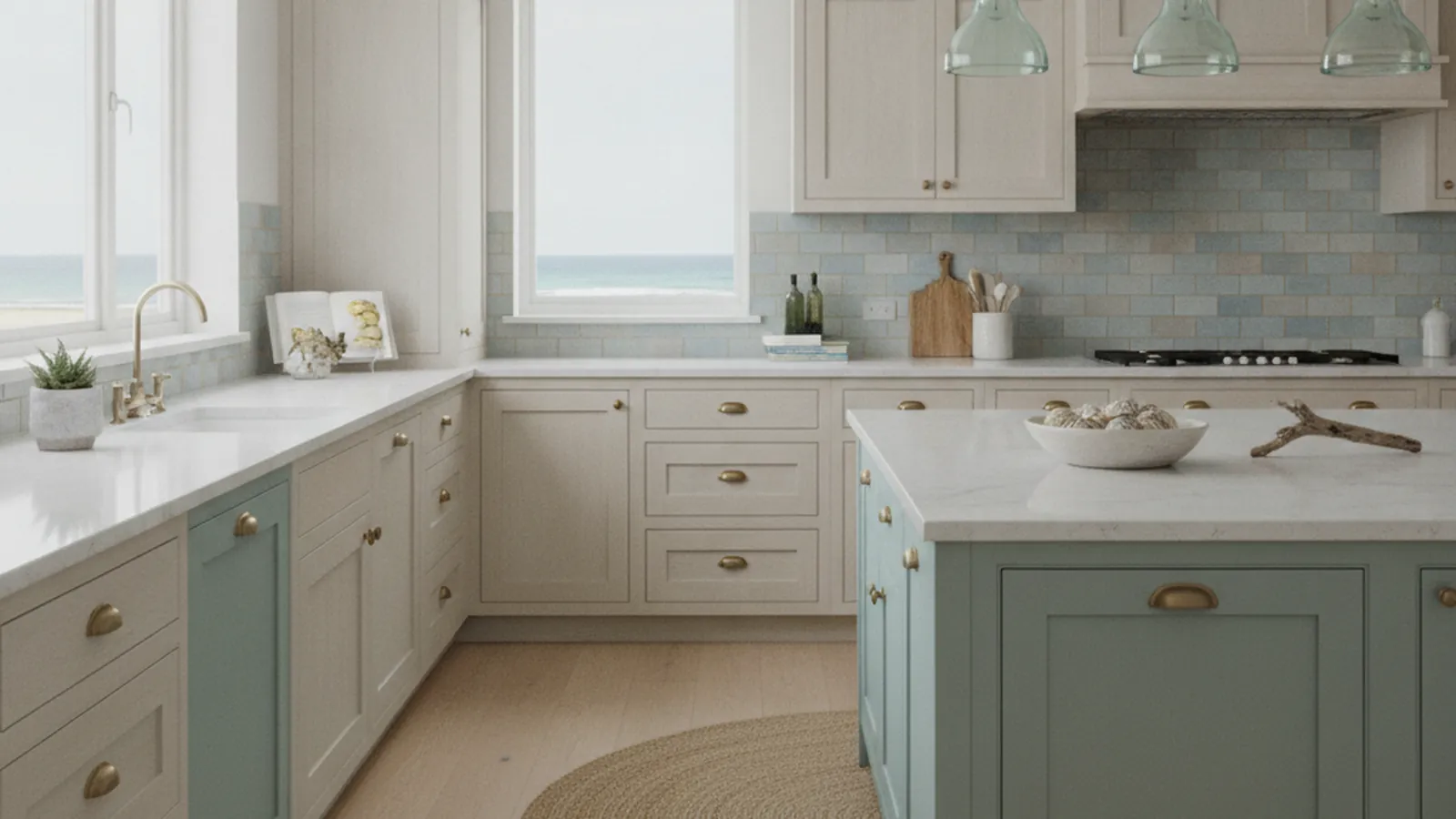
Cabinet Care & Maintenance
Coastal Salt Air and Cabinet Finishes
From Stinson Beach and Sea Ranch to the Outer Sunset and the Monterey coast: what salt and damp do to hardware and finishes, how a coastal kitchen is specified, and the one extra step in its care.
Quick Answer
How does salt air affect cabinetry, and what should a coastal kitchen be built and cared for with?
Salt air corrodes metal and keeps everything damp. Sea salt stays wet to very low humidity, so a deposit on a hinge or pull holds brine on the metal between fogs; and coastal interiors sit at a higher wood moisture content than inland ones — the Wood Handbook’s 11 percent average against 8 for most of the country.
The answer is specified before it is cleaned: a catalysed film finish on every face and edge, hinges in a corrosion-protected finish such as Blum’s BCOR, exposed stainless in grade 316 or a metal meant to patinate, enclosed air kept moving, and a weekly damp-then-dry wipe of the hardware.
Key Takeaways
- Sea salt stays wet until a very low relative humidity, so a salt deposit keeps corroding metal long after an inland surface would have dried. That one property explains most coastal hardware failures.
- Concealed hinges and runners are plated steel. Blum names warm damp air and cleaning-agent vapour as what damages them, and offers a BCOR galvanic coating tested to 48 h neutral and 24 h acetic-acid salt spray under DIN EN ISO 9227. On the open coast, specify it.
- For exposed stainless within about five kilometres of surf, ASSDA recommends grade 316 as a minimum and a surface roughness below 0.5 µm Ra; 304 and 430 will probably tea stain.
- The Wood Handbook’s interior moisture target for the damp, warm coastal area is 11 percent against 8 for most of the country. Coastal cabinetry lives at the wet end of its range and is finished on every face and edge to move evenly.
- A finish slows moisture exchange but cannot stop it. Two-part polyurethane and maleic alkyds have high moisture-excluding effectiveness in the handbook’s table; linseed oil falls to zero within a week.
- Ventilation is about the air inside the boxes, not the windows. Vent the sink base, use the hood, leave doors ajar in fog, and wipe hardware damp-then-dry once a week.
What Does Salt Air Actually Do to a Kitchen?
Two things, and they are separate problems: it corrodes metal, and it keeps everything damp for longer than inland air would.
Sea salt is not ordinary table salt on a surface. The Australian Stainless Steel Development Association’s guidance on coastal corrosion makes a point that explains most of what owners see near the ocean: sea salt has the characteristic of staying wet until a very low relative humidity. A salt deposit on a hinge, a pull or a drawer slide therefore holds a film of brine on the metal through conditions that would dry an inland surface in minutes, and corrosion proceeds for as long as the film persists. That is why a kitchen two hundred yards from the surf at Stinson Beach or Sea Ranch can show pitting on plated hardware that an identical kitchen in Mill Valley never does, even though both get the same fog.
The second problem is humidity, and it is a wood problem rather than a metal one. The Forest Products Laboratory’s Wood Handbook gives recommended moisture content for interior woodwork, flooring and furniture at the time of installation: an average of 8 percent for most areas of the United States, 6 percent for the dry southwestern area, and 11 percent — with individual pieces anywhere from 8 to 13 — for the damp, warm coastal area. Its outdoor equilibrium table lists two California stations, and the contrast between them is the point: Los Angeles, on the coast, runs between 12.1 and 15.1 percent across the year, high and nearly flat, while Fresno, inland, swings from 7.8 percent in July to 16.6 in December. The flat, high curve is the shape of the open coast. Cabinetry on the Marin or Sonoma coast lives closer to the top of that range than anything built for Sacramento, and it is built, finished and cared for with that in mind.
What salt air does not do is attack a sound film finish directly. The finishes used on custom cabinetry are tested against far harsher reagents than brine — the Kitchen Cabinet Manufacturers Association’s published summary of the ANSI/KCMA A161.1 finish tests includes vinegar, lemon, orange and grape juices, ketchup, coffee, olive oil and 100-proof alcohol for 24 hours, and a hot box at 120 degrees Fahrenheit and 70 percent relative humidity for 24 hours. A coastal finish fails at its edges and gaps, where moisture reaches the wood, and at the metal passing through it — the three places this guide concentrates on.
| Exposure | What the air does | What it means for hardware | Specification and care |
|---|---|---|---|
| Open coast, within sight of surf — Stinson Beach, Bolinas, Sea Ranch, Carmel, Pacific Grove | Salt aerosol on every surface the outside air reaches; air at or near outdoor humidity whenever a door or window is open. | Plated steel is at risk; ASSDA’s guidance for stainless within about five kilometres of surf is grade 316 as a minimum, and lower grades will probably tea stain. | Film finish on every face and edge; interior of boxes finished; rinse-and-dry routine for exposed metal; mechanical ventilation that is used. |
| Fog belt, a few blocks inland — Outer Sunset and Richmond in San Francisco, Pacifica, Half Moon Bay, Santa Cruz west side | Persistent high humidity for weeks in summer; salt carried on wind and fog rather than spray. | Tea staining of lower stainless grades still likely by ASSDA’s account, which notes staining can extend 20 kilometres or more where wind and exposure are high. | Same finish rules; dehumidification or ventilation during the fog season; hardware wiped dry rather than left wet. |
| Bay and sheltered coast — Sausalito, Tiburon, Belvedere, Alameda, Monterey harbour | Damp but less salt-laden; the Wood Handbook’s “damp, warm coastal” interior target applies. | Standard nickel-plated hardware generally serviceable if kept dry; sink bases and dishwasher bays remain the weak points. | Balanced coats, finished edges, under-sink ventilation and the ordinary care routine. |
Which Cabinet Hardware Survives a Coastal Kitchen?
The hardware you can see is a choice of alloy. The hardware you cannot see is mostly plated steel, and the manufacturers say so.
The concealed hinges in most custom cabinetry are steel with a plated finish, and the plating is the part that corrodes. Blum describes the environments that threaten them without euphemism: warm, damp air, or vapours from chemical substances such as cleaning agents or assembly aids such as silicone, can damage the surface finish of fittings. Its answer is BCOR, a galvanically applied coating that the company says forms a protective shield around the hinge and has withstood a 48-hour neutral salt-spray test and a 24-hour acetic-acid salt-spray test under DIN EN ISO 9227, with the results confirmed by independent testing institutes. Many of its hinge types are available in both the standard finish and the BCOR finish. For a kitchen on the open coast, that choice is the specification: it is made at the drawing stage, not after the first hinge spots.
Pulls, knobs and any exposed stainless are a different decision. ASSDA’s coastal guidance is specific about tea staining — the brown surface discolouration of stainless steel by corrosion, which it notes is cosmetic and does not affect structural integrity. It occurs most commonly within about five kilometres of the surf and becomes progressively worse closer to the source, and wind exposure, pollution and heat can extend it to 20 kilometres or more. Within that zone the association recommends grade 316, or a grade of equivalent corrosion resistance, as a minimum, and says plainly that the lower-alloyed grades such as 304 or 430 will probably become tea stained. It also recommends a surface roughness below 0.5 micrometres Ra, because a smoother surface holds less salt; a mirror polish is the most resistant mechanically finished option. Solid brass and bronze pulls that are meant to patinate are the other honest answer for the open coast — they will change colour, and the owner should want them to.
The care side is as simple as the specification side. ASSDA’s advice for stainless is that a light and regular wash is best, that natural rain washing may be sufficient outdoors, and that abrasive cleaners, chloride-containing products and bleach should not be used because they damage the surface. Indoors, that translates to wiping pulls and the exposed parts of hinges with a damp cloth and drying them — the drying is the step that matters, because it removes the brine film that would otherwise sit on the metal until the next fog. Under the sink and behind the dishwasher, where warm damp air and cleaning vapour collect together, a hinge is doing the hardest work in the kitchen, and that cabinet should be checked and dried more often than the rest.
Which Finish Should a Coastal Kitchen Have?
A film finish, on every face and every edge, chosen for how well it slows water vapour. The Wood Handbook has measured that, and the ranking is not intuitive.
The Wood Handbook’s chapter on finishing defines moisture-excluding effectiveness as a finish’s resistance to the diffusion of water vapour, and it is careful about what that means: a coating that blocks all water vapour would be 100 percent effective, but no coating is impermeable, and a coating that excludes water vapour merely slows its absorption or desorption — it cannot change the equilibrium moisture content the wood is heading for. On a damp coast the wood is heading somewhere wetter than it would inland, and a finish is the thing that decides how fast it gets there and how evenly.
The handbook’s table of measured effectiveness on ponderosa pine separates the finishes that do this work from the finishes that do not. Maleic alkyds, two-part polyurethane and paraffin wax are named as having high effectiveness; linseed oil falls to zero after seven days, and latex flat wall paint is in the same territory. Porous paints, the text notes, afford little protection against water vapour transmission and may not repel liquid water either. For a cabinetmaker that ranking confirms the shop practice: a catalysed film — conversion varnish or a two-component polyurethane, both covered in detail in the mountain home guide’s finish article — on a coastal kitchen, and a penetrating oil only where the owner accepts that it does nothing to slow the moisture exchange and is prepared to maintain it accordingly.
Where the finish goes matters as much as which it is. The site’s finish-systems guide notes the Architectural Woodwork Standards rule that panel products and wood doors receive balanced coats of finishing material on both faces for stability and to remain free of warp, and the Wood Handbook explains the mechanism — a door whose two faces exchange moisture at the same slowed rate dries and dampens evenly instead of cupping. On a coast where the humidity swing is between damp and damper, the backs of doors, the edges of panels, the insides of cabinet boxes and the underside of every shelf are finished to the same build as the fronts, before the cabinetry leaves the Rocklin shop. An unfinished edge in a sealed cabinet is a wick, and a wick on the Sonoma coast is always damp.
Does Ventilation Help, or Does It Just Let More Salt In?
Both, which is why the useful distinction is between air that moves through the house and air that stagnates inside a cabinet.
An open window on the Marin coast brings in salt and humidity together. There is no arguing with that, and no reason to try: people buy houses at Stinson Beach to open the windows. The cabinetry question is narrower. It is whether the air inside the boxes — the sink base, the dishwasher bay, the blind corner, the tall pantry — is allowed to sit still and damp while the room air moves. Still, damp, enclosed air is the condition both the hinge manufacturer and the Wood Handbook describe as the one to avoid, and it is produced by closed doors, not open windows.
The practical measures are the ones that keep enclosed air moving and dry. A range hood that is actually used, vented to the outside, removes the cooking moisture that a coastal house cannot shed through its walls the way an inland house can. A sink base with a gap at the back or a small vent in the toe-kick is a cabinet whose hinges dry between uses. Doors left ajar during a week of fog, as owners of mountain second homes are told to leave them during a week of absence, keep both faces of a door in the same air. And a dehumidifier run in the fog season does, in a coastal kitchen, what a humidifier does in a Tahoe one — it holds the room nearer the moisture content the cabinetry was built at.
What ventilation cannot do is substitute for the specification. A kitchen with unfinished edges and standard-finish hardware will show the coast whatever the owner does with the windows; one with every face finished and corrosion-protected hardware will tolerate a great deal of fog. Specify first, ventilate second.
What Does Routine Care Look Like Within Sight of the Ocean?
The same routine as anywhere else, with one extra step at the end of it: dry the metal.
Finish manufacturers agree on the routine for sealed interior wood, and Sherwin-Williams’ published guidance is representative: in general, dry dusting is all that is needed; mild, diluted soapy water can be used infrequently to remove airborne contaminants, rinsed with only small amounts of water and dried afterwards, because too much water can soak into the wood and damage the finish; and cleansers containing paraffin or oils will leave a film that must be completely removed before any future recoat. On the coast the airborne contaminant is salt, and the reason to wipe a cabinet face near an open window is to take the salt off the finish before it is left to sit damp, not because the finish is in any danger from it.
The extra step is the hardware. A damp cloth over a pull or across the visible knuckle of a hinge, followed by a dry one, is the indoor equivalent of ASSDA’s light and regular wash, and it is the step that prevents the brine film from forming in the first place. It takes a minute a week. The cabinets to give that minute to are the ones nearest the doors to the deck, the sink base and the dishwasher bay — the first because they see the most salt, the other two because they see the most warm, damp air.
The signs that care has slipped are specific. Brown speckling on stainless is tea staining and, per ASSDA, is cosmetic; it is removed with a non-chloride stainless cleaner and prevented by the wiping routine. Rust bloom on a plated hinge cup is plating failure and the hinge is replaced, not cleaned. A door that drags on a neighbour in August and frees itself in October is wood movement within the range a coastal kitchen is built for; one that drags and does not recover, or a raised panel showing a bare line along one edge, is a moisture gradient that has gone one way too long, and a reason to find the damp air before touching the hinge.
Frequently Asked Questions
- Will salt air ruin the finish on my cabinets?
- Not a sound film finish on its face. The Kitchen Cabinet Manufacturers Association’s published A161.1 finish tests expose cabinet surfaces to vinegar, citrus juices, coffee, olive oil and 100-proof alcohol for 24 hours and to a 120-degree, 70-percent-humidity hot box for a further 24; brine is milder than most of that list. Coastal finishes fail at unfinished edges and at gaps where moisture reaches the wood, and at the metal passing through them — which is why every face and edge is finished and the hardware is chosen for the coast.
- Which hinges should I specify for a house at Stinson Beach or Sea Ranch?
- Blum states that warm, damp air and vapours from cleaning agents or silicone can damage the surface finish of fittings, and offers its BCOR galvanic coating — tested to a 48-hour neutral salt-spray and a 24-hour acetic-acid salt-spray exposure under DIN EN ISO 9227 — for exactly those conditions, on many of the same hinge types as its standard finish. On the open coast the BCOR version is the specification. It is decided at the drawing stage.
- Is 304 stainless good enough for cabinet pulls near the ocean?
- The Australian Stainless Steel Development Association’s coastal guidance says the lower-alloyed grades such as 304 or 430 will probably become tea stained within about five kilometres of the surf, and recommends grade 316 or equivalent as a minimum there, with a surface roughness below 0.5 micrometres Ra. Tea staining is cosmetic — it does not affect structural integrity — but on a visible pull it is exactly what the owner does not want.
- Why is sea salt worse for hardware than the salt in a kitchen?
- Because, in ASSDA’s words, sea salt has the characteristic of staying wet until a very low relative humidity. A deposit of it holds a film of brine on the metal through conditions that would dry an inland surface in minutes, so corrosion continues for as long as the film persists. Wiping hardware with a damp cloth and then a dry one removes the deposit before the film forms.
- Which cabinet finish holds up best in damp coastal air?
- A catalysed film finish applied to every face and edge. The Wood Handbook defines moisture-excluding effectiveness as a finish’s resistance to water-vapour diffusion, notes that no coating is impermeable — it slows moisture exchange but cannot change the equilibrium moisture content — and names two-part polyurethane and maleic alkyds among the high performers, with linseed oil at zero after seven days. The site’s finish-systems guide notes the standards’ balanced-coats rule: both faces finished alike so the door moves evenly.
- Should I keep the windows closed to protect the cabinetry?
- No. The condition to avoid is still, damp air trapped inside a cabinet, not moving air in the room. Use the range hood, vent or gap the sink base, leave doors ajar through a week of fog, and run a dehumidifier in the fog season if the house holds moisture. Those keep the air inside the boxes moving and nearer the moisture content the cabinetry was built at — the Wood Handbook’s 11 percent average for damp coastal interiors.
References
- Australian Stainless Steel Development Association — Preventing Coastal Corrosion (Tea Staining). Distance from surf, sea-salt behaviour, grade and surface-finish selection, cleaning.
- Blum — Hinges with BCOR Surface Protection (product overview). Galvanic coating; 48 h NSS and 24 h AASS testing to DIN EN ISO 9227; independent confirmation.
- Blum — Hinges with BCOR Surface Protection: Quality Down to the Last Detail (product flyer FL-327). Causes of surface damage to fittings; programme of hinge types available in standard and BCOR finish.
- USDA Forest Products Laboratory — Wood Handbook: Wood as an Engineering Material, FPL-GTR-190 (2010). Table 13–1 (outdoor EMC, Los Angeles), Table 13–2 (recommended moisture content at installation, damp coastal area), Chapter 16 (moisture-excluding effectiveness; Table 16–3).
- Kitchen Cabinet Manufacturers Association — Cabinets Certified to Last (2023): summary of the ANSI/KCMA A161.1 finish tests.
- Sherwin-Williams — Staining FAQs: cleaning and maintaining sealed interior woodwork.
- PineWood Cabinets — Cabinet Finish Systems: Cure Chemistry and How Durability Is Measured (balanced finish coats on doors and panels).
Explore
One Care Routine, Three Climates
Salt, smoke and altitude each remove the margin for skipping an ordinary step. The regional care guides, the construction behind them, and where each applies.
In This Guide
Construction Background
Where It Applies
Continue Reading
Related Guides
More in This Guide
Related Reading
Continue Learning
Planning a kitchen and want to talk it through with the person who will build it?
Request a Design Consultation