Permits & Process by Jurisdiction
Sonoma County Kitchen Permits
Permit Sonoma’s own exempt-work list, Santa Rosa’s state-code rule, and the six incorporated counters — what each says about cabinets, and where the layout, not the cabinetry, becomes the trigger.
Quick Answer
Does a kitchen cabinetry project in Sonoma County need a permit?
Permit Sonoma’s BPC-005 exempts “Painting, interior papering, tiling, carpeting, cabinets, counter tops, and similar finish work” and says to assume a permit is required for anything not on its list. Santa Rosa requires a permit unless the California Building Code expressly exempts the work. A new circuit, a moved sink or an opened wall triggers one in both.
Unincorporated parcels — Glen Ellen, Kenwood, Dry Creek, the coast — apply to Permit Sonoma; the six cities and town take their own applications.
Key Takeaways
- Permit Sonoma permits virtually all construction in the unincorporated county, which includes most of the wine country and the whole coast; Santa Rosa, Petaluma, Healdsburg, Sebastopol, Sonoma and Windsor permit inside their own limits.
- BPC-005 names cabinets and counter tops as exempt finish work, and frames the list with the rule that any unlisted project should be assumed to require a permit.
- Exempt is not unregulated: BPC-005 states exempt work must be code compliant and may be subject to well and septic, zoning, drainage or sewer review.
- Santa Rosa publishes no list of its own; it requires a permit unless the California Building Code Section 105 exempts the work, and takes applications only as PDFs through Accela.
- No fees or turnaround times are given here: Santa Rosa says its schedule changes each January 1 and July 1, and neither its schedule nor Permit Sonoma’s was fetched for this guide.
Who Issues a Kitchen Permit in Sonoma County?
Permit Sonoma for everything unincorporated — which is most of the wine country and all of the coast — and six city halls for the parcels inside their limits.
Sonoma County consolidated its planning, building and permitting functions into a single agency, Permit Sonoma, which its own home page describes as reviewing, permitting and inspecting “Virtually any land development or construction that takes place in the unincorporated area of Sonoma County.” That unincorporated area is large and includes most of what people mean by wine country: Glen Ellen and Kenwood in Sonoma Valley, Dry Creek Valley and the Alexander Valley vineyards outside Healdsburg, Graton and Occidental in the west county, and the entire coast from Bodega Bay to The Sea Ranch. Permit Sonoma’s pages state explicitly that incorporated cities are excluded from its jurisdiction.
The incorporated cities and town — Santa Rosa, Petaluma, Healdsburg, Sebastopol, Sonoma and Windsor — each run their own building counter. Santa Rosa’s is the only one whose page was retrievable for this guide; it is quoted below. The City of Petaluma’s site and the City of Sonoma’s building FAQ both refused retrieval, and the Healdsburg, Sebastopol and Windsor building pages were not fetched, so this guide does not describe their scope lists, portals or hours. All six enforce the same California Building Standards Code that Permit Sonoma does, and their municipal sites are linked in the references as the place to start.
The parcel decides the office, and in Sonoma County the postal address is a poor guide. A Healdsburg address in Dry Creek Valley is county; a Sonoma address in Glen Ellen is county; a Santa Rosa address on the edge of Bennett Valley may be either. Permit Sonoma’s portal and each city’s GIS will settle it, and settling it first avoids drawing a plan set in one office’s format for another office’s counter.
| Jurisdiction | Who issues | Typical trigger | Where to apply | Source |
|---|---|---|---|---|
| Unincorporated Sonoma County — Glen Ellen, Kenwood, Dry Creek Valley, Alexander Valley outside Healdsburg, Graton, Occidental, Bodega Bay, The Sea Ranch and the rest of the coast | Permit Sonoma (Sonoma County’s consolidated planning and permitting agency, formerly PRMD) | BPC-005 exempts “Painting, interior papering, tiling, carpeting, cabinets, counter tops, and similar finish work”; “If your project does not appear on this list of exempt work, you should assume that a building permit is required” | Online Permitting through the county’s Accela portal; Permit Center in person (closed Fridays) | Permit Sonoma home page; BPC-005; Building & Construction Permits page |
| City of Santa Rosa | City of Santa Rosa Building Division | “A Building Permit is required unless it is expressly exempted by the California Building Code,” with the exemption list in CBC Chapter 1, Section 105; permits cover work to “construct, enlarge, alter, repair, move, demolish or change the occupancy” and electrical, gas, mechanical and plumbing systems | Accela Citizen Access Portal, PDF only; in-person by appointment at City Hall, 100 Santa Rosa Avenue, Room 3 | City of Santa Rosa Building Permits page |
| City of Petaluma | City of Petaluma (incorporated; its own counter) | Same state code; the city’s site refused retrieval for this guide | City of Petaluma | Not fetched — see note in text |
| City of Healdsburg | City of Healdsburg (incorporated; its own counter) | Same state code; the city’s building page was not fetched for this guide | City of Healdsburg | City of Healdsburg website (home page fetched) |
| City of Sebastopol | City of Sebastopol (incorporated; its own counter) | Same state code; the city’s building page was not fetched for this guide | City of Sebastopol | City of Sebastopol website (home page fetched) |
| City of Sonoma | City of Sonoma (incorporated; its own counter) | Same state code; the city’s building FAQ refused retrieval for this guide | City of Sonoma | City of Sonoma website (home page fetched) |
| Town of Windsor | Town of Windsor (incorporated; its own counter) | Same state code; the town’s building page was not fetched for this guide | Town of Windsor | Town of Windsor website (home page fetched) |
What Does Permit Sonoma Say Needs No Permit?
Permit Sonoma publishes the most complete answer of any jurisdiction in this guide series, in a document called BPC-005, and it names cabinets and counter tops explicitly.
Permit Sonoma’s Building and Construction Permits page asks the homeowner’s question in the homeowner’s words — “Building a fence, replacing cabinets in your kitchen?” — and points to its list of work that can be done without a building permit. That list is BPC-005, “When Is a Building Permit Not Required?”, version dated 05/26/2023. Its building section exempts “Painting, interior papering, tiling, carpeting, cabinets, counter tops, and similar finish work,” along with in-kind replacement of windows and doors of the same size in the same location where the structural frame is not altered, and minor interior paneling or gypsum repair up to 100 square feet outside fire-resistive or bracing walls. Its electrical section exempts minor repairs, lamp replacement, replacing attachment plug receptacles, and repairing or replacing branch circuits or overcurrent devices of the same capacity in the same location. Its plumbing section exempts stopping leaks and clearing stoppages, with the standard caveat that replacing a defective concealed trap or pipe requires a permit and inspection.
The document frames the list with three statements a homeowner should read as carefully as the list itself. First: “If your project does not appear on this list of exempt work, you should assume that a building permit is required.” Second: “The exempt construction/work must be code compliant.” Third: exempt work “may be subject to other county regulations (Well & Septic, Use or Zoning, Drainage, Sewer, etc.),” and “It is important to contact the appropriate staff at Permit Sonoma to determine if any other permit or technical review is required.” The first statement is the rule; the other two are the reasons a cabinet replacement in Kenwood is not the same conversation as one in Santa Rosa.
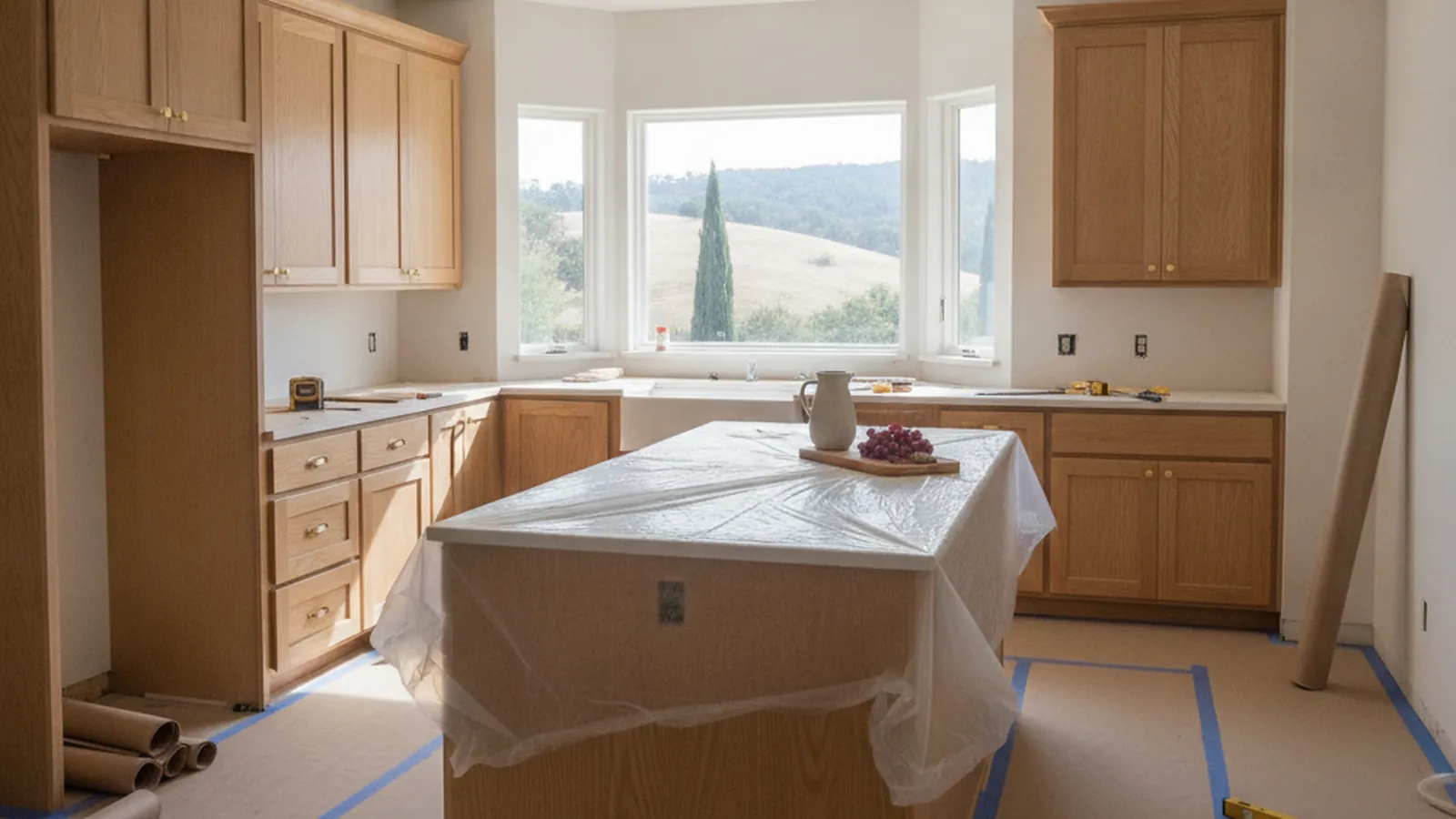
Applied to a kitchen, the line falls where it falls everywhere else. New cabinetry and counters on the existing layout, the sink reconnected where it was, the same circuits feeding the same receptacles — finish work, no building permit. An island with a receptacle is a new branch circuit, which BPC-005’s electrical exemption does not cover. A sink moved to a new wall is a rearranged drain, which its plumbing exemption does not cover. A wall opened to the dining room is structural, which nothing on the list covers. The cabinets are never the trigger; the layout is.
How Does Santa Rosa Handle the Same Question?
By pointing at the state code rather than reproducing it, and by running an all-digital intake.
The City of Santa Rosa’s Building Permits page does not publish its own exempt list. It states that “A Building Permit is required unless it is expressly exempted by the California Building Code,” directs the reader to Chapter 1, Section 105 of that code for the exemptions, and warns applicants not to begin a project before they know their permitting obligations. It defines the scope of a permit broadly — work that would “construct, enlarge, alter, repair, move, demolish or change the occupancy of a building,” and work on electrical, gas, mechanical and plumbing systems — and states that only properly licensed contractors or owner-builders may obtain one. Section 105 of the California Building Code is the same source the county’s BPC-005 draws on, so the finish-work exemption for cabinets and counter tops applies inside Santa Rosa as it does outside; the difference is that the county has written it out and the city has not.
Santa Rosa’s intake is through the Accela Citizen Access Portal. The city’s page states that “Only .pdf file types are accepted,” with each form as a separate PDF; that in-person submittals are by appointment only, at City Hall, 100 Santa Rosa Avenue, Room 3; and that its Building@srcity.org address is for questions only, with “no application submittals are accepted at this email address.” On fees, the page says the city’s fee schedule is revised each January 1 and July 1 and that some plan review fees must be paid in advance; it gives no figures and nor does this guide. Plan check turnaround times are in a separate city document that was not fetched, so no timeline is given either.
For a kitchen in the Fountaingrove rebuild area, in the McDonald Avenue historic district, or in the ranch neighbourhoods off Montgomery Drive, the practical reading is the same: cabinetry on the existing layout is state-code finish work and the city’s counter can confirm it; a new layout with new circuits, a moved sink or an opened wall is a permit through Accela, PDFs only, with the cabinet drawings as an exhibit in the plan set.
Does the Coast or a Design Committee Change the Answer?
Not for the cabinetry. For the exterior, the answer can be two reviews rather than one, and Permit Sonoma’s pages fetched for this guide do not say how.
The Sea Ranch, Bodega Bay and the rest of the Sonoma coast are unincorporated and permitted by Permit Sonoma. The coast is also within California’s Coastal Zone, where exterior development is subject to coastal permitting in addition to a building permit. None of the Permit Sonoma pages fetched for this guide — the home page, BPC-005, the Building and Construction Permits page — addresses coastal-zone review at all, so this guide does not describe when it applies or how it is administered. What can be said is that it is an exterior and land-use matter: a kitchen cabinetry project inside an existing coastal house is finish work under BPC-005 like any other, and the coastal question arises only when the project reaches a window, a wall or the ground outside the foundation. Ask Permit Sonoma before changing any of those on a coastal parcel.
Communities with their own design review — The Sea Ranch is the best-known, and several Sonoma Valley and Healdsburg-area developments have architectural committees — add a private layer that likewise concerns the exterior. A design committee does not review a kitchen interior; it reviews the window enlarged over the new sink and the vent hood cap on the roof. BPC-005’s own caveat applies here in a different form: exempt from a building permit is not the same as exempt from every approval, and the approvals that remain are the ones that look at the house from outside.
Permit Sonoma also notes on its home page that its fire-rebuild program changes on January 1, 2027, when “certain fee waivers and special allowances will expire” while expedited review continues. That is relevant to kitchens only in the rebuilt neighbourhoods of the 2017 and 2020 fire footprints, where a rebuilt house is a new building rather than a remodel and the permit was always required; it is noted here because the county states it, and because owners finishing rebuilds should read the program page before the date.
How Does a Sonoma County Permit Affect a PineWood Project?
The cabinetry is built in Rocklin and delivered over the valley. Sonoma County projects run on the same sequence as everywhere else; the distance makes rough-in confirmation matter more, not less.
For a kitchen in Glen Ellen, Kenwood or the Dry Creek Valley that keeps its plumbing wall, range location and circuits, BPC-005 means there is nothing to apply for before cabinetry is measured, built and installed. For a kitchen that moves any of those, the general contractor or the trade pulls the permit through Permit Sonoma’s portal or the city’s, the inspector signs off rough electrical and rough plumbing before the walls close, and we confirm final cabinet dimensions against the roughed-in locations on site. We do that everywhere; we are stricter about it in Sonoma County because a two-hour drive separates a measurement from a correction, and a sink base cut to a drain that moved an inch is not something to discover on a Friday with the Permit Center closed.
Estate kitchens in the wine country tend to be the projects that touch the exterior — a window wall opened to a vineyard, a pass-through to an outdoor dining terrace — and those are the projects where the permit conversation should happen in the design consultation rather than at the counter. Which wall stays, which window grows and whether the island carries a sink are design decisions with permitting consequences, and in a design-review community or on the coast they can be the difference between one approval and three. We put those choices in front of the owner early, with the county’s or the city’s own text beside them.
Nothing on this page is legal advice, and no Sonoma County office has reviewed it. Every quotation is from the document named beside it; the scope of a specific project should be confirmed with the office that will inspect it, and the five city pages that were not fetched should be read at the source.
Frequently Asked Questions
- Do I need a permit to replace kitchen cabinets in unincorporated Sonoma County?
- Not for the cabinets themselves. Permit Sonoma’s BPC-005 lists “Painting, interior papering, tiling, carpeting, cabinets, counter tops, and similar finish work” as exempt from a building permit. The same document says to assume a permit is required for anything not on its list, which brings in new circuits, a relocated sink or any structural change.
- Which office permits a kitchen in Glen Ellen, Kenwood or Dry Creek Valley?
- Permit Sonoma, the county’s consolidated permitting agency, because all three are unincorporated. Its home page states that it reviews and permits virtually any construction in the unincorporated area and that incorporated cities are excluded. Applications go through the county’s Accela online portal or the Permit Center, which is closed Fridays.
- What does Santa Rosa require for a kitchen remodel?
- Santa Rosa’s Building Permits page states that a permit is required unless the California Building Code expressly exempts the work, and points to CBC Chapter 1, Section 105 for the list. Applications go through the Accela Citizen Access Portal as PDFs only; in-person submittals are by appointment at City Hall, 100 Santa Rosa Avenue, Room 3.
- Does exempt work still have to meet code in Sonoma County?
- Yes. BPC-005 states that “The exempt construction/work must be code compliant,” and that exempt work may still be subject to other county regulations such as well and septic, zoning, drainage or sewer. It advises contacting Permit Sonoma staff to determine whether any other permit or technical review is required.
- Is a kitchen at The Sea Ranch or on the coast treated differently?
- Not inside the house. The coast is unincorporated and permitted by Permit Sonoma, and BPC-005’s finish-work exemption applies there as anywhere else. The Permit Sonoma pages fetched for this guide do not address coastal-zone review, so this guide does not describe it; it is an exterior and land-use matter, and any change to a window, wall or the ground on a coastal parcel should be raised with Permit Sonoma first.
- Where are Sonoma County permit fees published?
- Permit Sonoma links a “Permit Instructions, Forms, Policies, & Fee Schedules” page from its home page, and Santa Rosa states that its fee schedule is revised each January 1 and July 1. Neither fee schedule was fetched for this guide, so no figures are given here.
References
Every jurisdiction statement above is attributed to one of the pages below, each fetched while this guide was written. The City of Petaluma is not listed because its site refused retrieval; read it directly. Hours, portals and fee schedules change; read the current page before relying on any of them.
- Permit Sonoma — home page (jurisdiction statement, online permitting, Permit Center hours)
- Permit Sonoma — BPC-005, When Is a Building Permit Not Required? (05/26/2023)
- Permit Sonoma — Building & Construction Permits
- City of Santa Rosa — Building Permits (served from the city’s CivicPlus host; srcity.org refused automated retrieval)
- City of Healdsburg
- City of Sebastopol
- City of Sonoma
- Town of Windsor
Explore
Sonoma County Pages and the Rest of the Series
The county hub and the community pages describe the homes; the sibling guides cover the foothill counties and the Tahoe Basin.
In This Guide
Sonoma County Service Areas
Services & Standards
Continue Reading
Related Guides
More in This Guide
Related Reading
Continue Learning
Planning a kitchen and want to talk it through with the person who will build it?
Request a Design Consultation