Mountain Home Cabinetry
Delivery and Installation Logistics
The calendar is written by the snow normals, the road rules by Caltrans, and the install by how long the cabinetry is given to settle into the house before the first screw.
Quick Answer
How is finished cabinetry delivered and installed at a Tahoe or Truckee home?
Around the snow. The NOAA normals give Tahoe City measurable snowfall from October through May and more than 34 inches a month from December through March, and Caltrans allows no snow-tire exemption for a loaded truck under chain controls, so winter deliveries wait for a window and summer ones simply need a driveway.
At the house the cabinetry goes straight into a conditioned room — never the garage — and settles before it is scribed and hung. On the California side PineWood’s own crews install under its CSLB licence. On the Nevada shore the cabinetry is delivered ready to set and a Nevada-licensed contractor installs it, as the Nevada State Contractors Board’s licensing rules require.
Key Takeaways
- The NOAA normals set the calendar: Tahoe City averages 37.9, 41.3, 34.7 and 36.2 inches of snow in January, February, March and December; Truckee 43.6, 47.9, 32.2 and 44.2. June through September are effectively snow-free at both.
- Caltrans Requirement 1 exempts passenger vehicles and light trucks under 6,000 pounds on snow tires; Requirement 2 exempts only four-wheel-drive vehicles with snow-tread tires on all four wheels; Requirement 3 exempts nothing. There is no snow-tire exemption for heavy-duty commercial vehicles.
- Over Donner Pass, Caltrans says heavy trucks are usually required to carry link-type chain on at least the main drive axle. A finished-cabinet load goes under R-1 and waits under R-2 and R-3.
- Staging in the garage is the commonest mistake. A Sierra garage in winter is near outdoor temperature; the Forest Products Laboratory’s in-service moisture content instruction is met only in a conditioned room.
- The heat goes on before the delivery, not after, and stays on through the install and for a period beyond it.
- On the Nevada shore PineWood supplies and a Nevada-licensed contractor installs. The Nevada State Contractors Board requires licensing before any contracting and excludes material suppliers from its definition of a contractor.
When Is the Road Reliably Open? Reading the Snow Normals
The delivery calendar for a lake house is not a guess. NOAA publishes thirty-year normal snowfall by month for the Tahoe City and Truckee stations, and the shape of those two rows is the shape of the season.
At the Tahoe City cooperative station, the 1991–2020 normals give monthly snowfall of 37.9 inches in January, 41.3 in February, 34.7 in March, 14.0 in April, 2.8 in May, 0.2 in June, zero in July and August, 0.1 in September, 2.4 in October, 9.4 in November and 36.2 in December. The Truckee ranger station runs heavier in every winter month: 43.6, 47.9, 32.2, 18.5 and 4.1 inches from January through May, under an inch from June through September, then 2.8 in October, 11.9 in November and 44.2 in December. Measurable normal snowfall exists at both stations from October through May; December through March carry the bulk of it.
Those are averages, and a normal is not a forecast — a given February can bury the average or miss it entirely. But the averages set expectations honestly. A delivery scheduled between June and September needs a driveway and someone to open the door. A delivery scheduled between December and March needs a weather window, a truck prepared for chain controls, a plowed and sanded approach at the house, and an installer or owner who can be there on the day the road allows, which may not be the day on the calendar. April, May, October and November are the shoulder months: usually fine, occasionally not, and the forecast decides.
There is a second reason to think about the calendar, and it has nothing to do with the road. The Forest Products Laboratory’s instruction is to install wood at the moisture content it will experience in service, and the companion guide on altitude and moisture explains why a heated Sierra house in January is at the dry end of its year. Cabinetry delivered in winter should arrive into a house that has already been heated for a while, so that it settles toward the room it will live in rather than toward a cold garage.
What Do Caltrans Chain Controls Mean for a Delivery Truck?
Caltrans defines three levels of chain control, and the exemptions that let a passenger car through on snow tires do not extend to a loaded truck.
Caltrans states that during the winter months motorists may encounter traction chain controls in the mountain areas within California, and that when chain controls are established, signs will be posted along the road indicating the type of requirement. Under Requirement 1, chains are required on all vehicles except passenger vehicles and light-duty trucks under 6,000 pounds gross weight equipped with snow tires on at least two drive wheels. Under Requirement 2, chains or traction devices are required on all vehicles except four-wheel or all-wheel-drive vehicles with snow-tread tires on all four wheels. Under Requirement 3, chains or traction devices are required on all vehicles, no exceptions.
The truck rules are stricter still. Caltrans’ chain-requirements page states that there is no exemption for heavy-duty commercial vehicles with snow tires — when chains are posted, trucks must have them mounted before proceeding. Over Donner Pass on Interstate 80, heavy trucks are usually required to carry link-type chain on at least the main drive axle, and inside duals are not usually required unless conditions are severe. Any vehicle towing a trailer must have chains on one drive axle, and a trailer with brakes must have chains on at least one of its own axles. Caltrans adds a practical note from its winter-driving page: there is usually about a mile between the Chains Required sign and the checkpoint, and the speed limit under chain control is 25 or 30 miles per hour.
What that means for finished cabinetry is simple. Under Requirement 1 the truck chains up and crosses slowly. Under Requirement 2 and Requirement 3 the honest decision is not to go. A box truck full of doors with a cured conversion-varnish finish, blanket-wrapped and strapped, is not a load to put on a chained axle at 25 miles per hour over a pass in a storm — and the Caltrans QuickMap, which shows chain controls in real time, is checked before the truck leaves Rocklin rather than at the bottom of the hill. Caltrans itself does not post the R-1, R-2 and R-3 labels on the road; the posted signs and the instructions of Caltrans and CHP personnel govern, and the shop follows them.
| Level | Caltrans definition | What it means for a cabinet delivery |
|---|---|---|
| Requirement 1 (R-1) | Chains are required on all vehicles except passenger vehicles and light-duty trucks under 6,000 pounds gross weight and equipped with snow tires on at least two drive wheels. Chains must be carried by vehicles using snow tires. | A loaded box truck is over the weight limit. It chains up at the checkpoint and proceeds at the posted 25 or 30 mph. |
| Requirement 2 (R-2) | Chains or traction devices are required on all vehicles except four-wheel or all-wheel-drive vehicles with snow-tread tires on all four wheels. Chains for one set of drive wheels must be carried by four-wheel-drive vehicles using snow tires. | No exemption for a delivery truck. In practice PineWood holds the load below the snow line and waits for the control to lift rather than run finished cabinetry over the pass under R-2. |
| Requirement 3 (R-3) | Chains or traction devices are required on all vehicles, no exceptions. | The road is effectively closed to a cabinet delivery. The day is rescheduled. |
Access, Staging and Protection at the House
The pass is the dramatic part. The last hundred feet — a steep lakefront driveway, a snow berm, a garage at outdoor temperature — are where cabinetry actually gets damaged.
Mountain driveways are steep, often tight, and in winter lined with the berms a plow leaves. A truck that cannot turn in the driveway unloads at the road, and every box is then carried past the berm, up the slope and through whatever door the house offers. That is planned at the site visit, not discovered on delivery day: the drawing set records where the truck can stand, which door the cabinetry comes through, whether an island top or a tall pantry box needs to be split for the stair, and who clears and sands the approach the morning of.
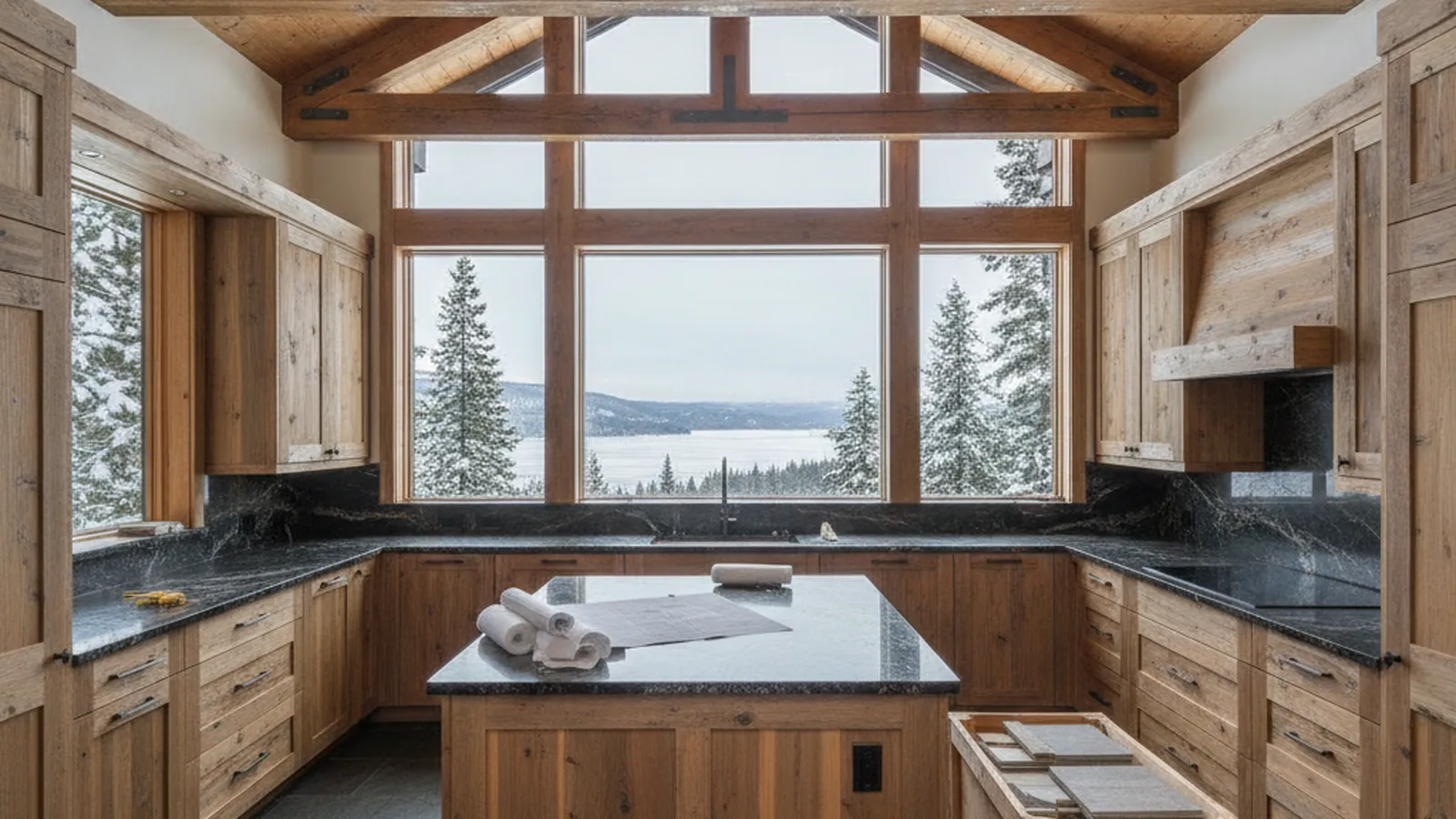
Staging is the part most often done badly, because the garage is right there. A garage in a Sierra house in winter sits close to the outdoor temperature, and cabinetry staged in it is being asked to settle toward a climate it will never live in. Finished cabinetry comes off the truck blanket-wrapped and goes straight into the conditioned part of the house — the great room, a bedroom, the kitchen itself once demolition is complete — and stays there, unstacked and with air around it, until it is scribed and hung. The Forest Products Laboratory’s instruction about in-service moisture content is met in the staging room or not at all.
Protection is physical as well as climatic. Floors are covered along the carry path. Doors and drawer fronts travel separately from boxes, wrapped face to face with padding between, and are hung last. Tall finished end panels and island faces are the most vulnerable pieces in the load and are carried flat rather than on edge. None of this is special to the mountains; what the mountains add is the carry past the berm and the temptation of the garage.
How the Installation Itself Changes at Altitude
The cabinetry is scribed to the house like any other, against the tolerances in ANSI/AWI 0620. What changes is the time between delivery and the first screw.
The installation standard requires product installed plumb and level within an eighth of an inch over 96 inches and requires casework to be scribed to finished walls and ceilings wherever voids occur — and mountain houses, with their timber frames, log walls and stone, produce more voids than most. The companion guide on installation tolerances covers the discipline in detail. What is different here is sequence: cabinetry that has been given time to settle in the conditioned house is scribed once, at the dimension it will keep; cabinetry hung the hour it arrives is scribed to a dimension it is still leaving.
For a second home this interacts with the thermostat. The guide on seasonal occupancy explains why a house brought from a deep setback to full heat in an afternoon dries its air far faster than solid wood can follow. The installer’s request is therefore that the heat goes on before the delivery, not after, and that the house is held at its occupied temperature through the install and for a period after. A kitchen installed into a house that is then shut down and winterised the following week has been asked to cross the whole swing in its first month.
Crews travel from the Rocklin workshop, as they do to every California project. The work is done under California contractor licence 1095293, which is the licence that covers the California side of the basin and Truckee. It stops at the state line.
The Nevada Shore: Supplied, Not Installed
Incline Village, Crystal Bay, Glenbrook, Zephyr Cove and Stateline are in Nevada, and a California contractor licence does not cross the state line. The arrangement there is different, and it is stated plainly.
The Nevada State Contractors Board’s licensing page states that all contractors must be licensed prior to contracting — bidding, offering to engage, or negotiating a price — and defines a contractor as one who undertakes or offers to construct, alter, repair or demolish a building or other structure, including subcontractors and specialty contractors. The same definition excludes material suppliers. That boundary is the one PineWood Cabinets works within on the Nevada shore: the kitchen is designed with the owner, built and finished in the Rocklin workshop, and delivered ready to set; a Nevada-licensed contractor installs it and carries the Washoe County or Douglas County permitting.
Logistically the Nevada delivery is the same drive with a different handoff. The truck faces the same Caltrans chain controls as far as the state line, the same driveway and staging questions at the house, and the same need for a conditioned room to settle in. What changes is who signs for the load and who hangs it. PineWood coordinates the drawings, the hardware schedule and the delivery date with the installing contractor so that the design intent carries through, and the installing contractor takes over from the moment the cabinetry is inside the door.
The permits guide explains why the two reviews — county and TRPA — are handled separately on the Nevada side, where TRPA’s delegation agreements with Washoe and Douglas counties are listed as inactive. For an interior cabinet replacement that is usually academic, since interior remodeling sits on TRPA’s exempt list and cabinets sit on Washoe County’s. It becomes real the moment the project touches plumbing, electrical, a wall or the footprint, and at that point the Nevada-licensed contractor is the right party to carry it.
Frequently Asked Questions
- What is the best time of year to have cabinetry delivered to Lake Tahoe or Truckee?
- The NOAA normals show measurable snowfall at Tahoe City from October through May and essentially none from June through September, with December through March each averaging more than 34 inches. Summer and early autumn are the predictable windows; winter deliveries are possible on good days but depend on Caltrans chain controls and a plowed approach at the house.
- Can a cabinet delivery truck cross Donner Pass under chain controls?
- Under Requirement 1, yes, chained up and at the posted 25 or 30 miles per hour. Caltrans states there is no snow-tire exemption for heavy-duty commercial vehicles, and over Donner Pass heavy trucks are usually required to carry link-type chain on at least the main drive axle. Under Requirement 2 — where only four-wheel-drive vehicles with snow-tread tires on all four wheels are exempt — and Requirement 3, where there are no exceptions, PineWood reschedules rather than run finished cabinetry over the pass.
- Where should cabinetry be staged when it arrives at a mountain house?
- In the conditioned part of the house, never the garage. A Sierra garage in winter sits near the outdoor temperature, and the Forest Products Laboratory’s instruction to install wood at the moisture content it will experience in service can only be met in a room at that condition. Boxes and doors are unwrapped, kept apart with air around them, and left to settle before anything is scribed.
- Should the heat be on before the cabinetry is delivered?
- Yes, and for a while beforehand. The house should be at its occupied temperature when the cabinetry arrives, through the installation, and for a period afterwards, so the wood settles toward the climate it will live in. A kitchen installed into a cold house that is then heated — or into a warm one that is then winterised the next week — crosses its whole seasonal swing in its first month.
- Does PineWood install on the Nevada side of the lake?
- No. PineWood Cabinets holds a California contractor licence, and the Nevada State Contractors Board requires all contractors to be licensed before bidding, offering to engage or negotiating a price in Nevada. Its definition of a contractor excludes material suppliers, which is the role PineWood takes for Incline Village, Crystal Bay, Glenbrook, Zephyr Cove and Stateline: the cabinetry is built and finished in Rocklin and delivered ready to set, and a Nevada-licensed contractor installs it and carries the permits.
- How is a lakefront driveway handled on delivery day?
- It is planned at the site visit rather than solved on the day. The drawing set records where the truck can stand, which door the cabinetry comes through, whether any tall box or island top must be split for a stair, and who clears and sands the approach that morning. Finished end panels and island faces are carried flat; doors and drawer fronts travel wrapped face to face and are hung last.
References
- NOAA National Centers for Environmental Information — U.S. Climate Normals 1991–2020, monthly snowfall, precipitation and temperature, stations USC00048758 (Tahoe City, CA) and USC00049043 (Truckee RS, CA).
- NOAA NCEI — U.S. Climate Normals (product page).
- Caltrans — Chain Controls: Requirement 1, 2 and 3.
- Caltrans — Chain Requirements for trucks, trailers and vehicles towing (Donner Pass drive-axle note).
- Caltrans — Winter Driving Tips (carrying chains; distance from signs to checkpoint; speed under chain control).
- Caltrans QuickMap — real-time road conditions and chain controls.
- USDA Forest Products Laboratory — Wood Handbook: Wood as an Engineering Material, FPL-GTR-190 (2010). Chapter 13, Recommended Moisture Content.
- Nevada State Contractors Board — License Requirements.
- California Contractors State License Board.
- Architectural Woodwork Institute — ANSI/AWI 0620 Finish Carpentry and Installation (plumb and level tolerance; scribing to finished walls).
Explore
Getting It There Is Half the Job
The permits guide decides who signs for the work; the occupancy guide decides what the house does to it once it is in.
Construction Background
Continue Reading
Related Guides
More in This Guide
Related Reading
Continue Learning
Planning a kitchen and want to talk it through with the person who will build it?
Request a Design Consultation