Design Insights
Quartz vs. Granite: Countertop Material Comparison
Explore quartz vs. granite: countertop material comparison and their applications in custom cabinetry and luxury kitchen design.
An Honest Comparison of Quartz and Granite for Luxury Kitchen Surfaces
The Countertop Decision
Countertops are the most visible and most used surfaces in any kitchen. They define the room's character, endure decades of daily abuse, and represent a substantial portion of the project budget. For luxury kitchens, the choice typically comes down to two materials: engineered quartz and natural granite. Both are excellent, but they are fundamentally different products with different strengths, weaknesses, and personalities.
We have installed thousands of countertops in our custom kitchens across California, and we have seen both materials perform beautifully and both materials fail. The key to a successful countertop is matching the material to the client's aesthetic preferences, cooking habits, and willingness to maintain the surface. Neither quartz nor granite is universally "better" -- the right choice depends entirely on you.
Here is what we have learned from real-world experience, not marketing brochures.
Understanding the Materials
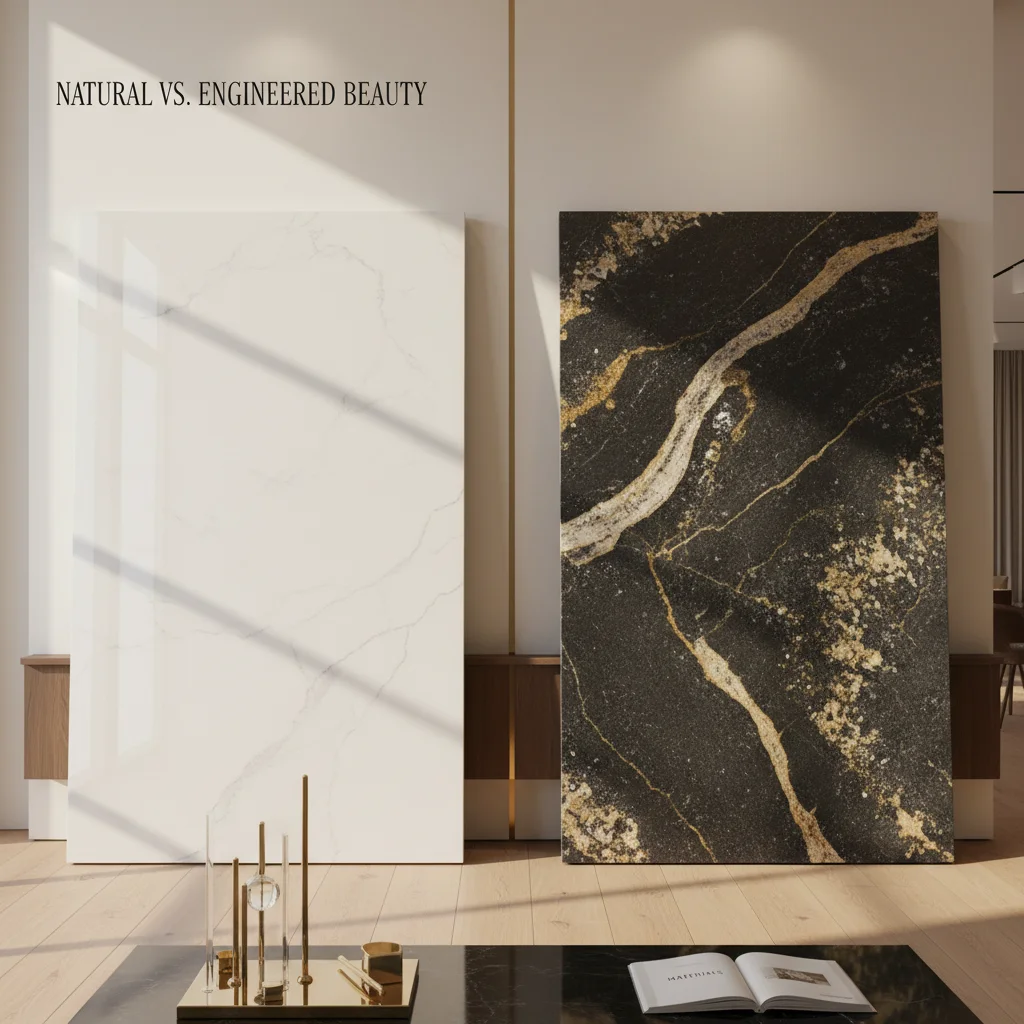
Granite is a natural igneous rock quarried from the earth in massive blocks, then sliced into slabs and polished. Every slab is unique -- formed over millions of years by geological processes that create unrepeatable patterns of mineral crystals, veins, and color variations. What you see at the stone yard is exactly what you get, and no two kitchens with granite will ever look the same.
Engineered quartz, by contrast, is a manufactured product. Roughly 90 to 94 percent ground natural quartz crystals are combined with polymer resins, pigments, and sometimes recycled glass or metallic flecks. The mixture is pressed into slabs under intense heat and pressure. Major brands include Caesarstone, Cambria, Silestone, and MSI. Because quartz is engineered, its appearance is highly consistent from slab to slab -- a significant advantage for large kitchens or projects requiring multiple slabs that must match.
Durability and Performance
Both materials are hard and durable, but they respond differently to common kitchen hazards. Granite rates 6 to 7 on the Mohs hardness scale, making it highly resistant to scratching. It tolerates heat well -- you can place a hot pan directly on granite without damage, something we regularly demonstrate to skeptical clients. However, granite is porous. Without periodic sealing (typically once or twice per year), it can absorb liquids, particularly oils, red wine, and acidic substances like lemon juice, leading to staining.
Engineered quartz is non-porous because the resin binder seals the surface completely. It never needs sealing, resists staining from virtually any household substance, and cleans up easily with just soap and water. This makes quartz particularly appealing for families with young children or for homeowners who prefer zero maintenance. However, quartz has a significant weakness: heat sensitivity. The resin binder can scorch or discolor at temperatures above 300 degrees Fahrenheit, which means hot pots and pans must always go on a trivet, never directly on the surface.
Impact resistance is comparable between the two materials, though granite has a slightly higher risk of chipping at the edges because it is a natural stone with micro-fractures. Quartz edges are more uniform and slightly more resilient, though neither material is indestructible. In both cases, a mitered or eased edge profile reduces chipping risk compared to a sharp, square edge.
Aesthetic Considerations
This is where personal preference plays the largest role. Granite offers a depth and complexity that engineered materials cannot fully replicate. A slab of Calacatta granite or Blue Bahia granite is a piece of natural art -- luminous, three-dimensional, alive with movement. When backlit or viewed from different angles, the crystals within the stone catch light in ways that manufactured surfaces do not. For clients who prioritize natural beauty and uniqueness, granite is hard to beat.
Quartz has made enormous strides in mimicking natural stone aesthetics. Brands like Caesarstone and Cambria now produce slabs that convincingly emulate Calacatta marble, Carrara marble, and various granite patterns. The latest manufacturing techniques create through-body veining that extends from the surface into the slab's depth, visible at edges and waterfall applications. For clients who want the look of marble without marble's notorious maintenance demands, these quartz options are compelling.
Color consistency is a key differentiator. If your kitchen requires three or four slabs to cover the perimeter and island, matching granite slabs can be challenging -- each slab from the same block will be similar but not identical. Quartz slabs from the same production batch are virtually indistinguishable, making large installations visually seamless. This is particularly important for waterfall island edges, where any mismatch between the horizontal and vertical surfaces is immediately apparent.
Cost Comparison
Pricing for both materials varies widely depending on the specific product. Entry-level granite starts around $50 per square foot installed, while premium exotic slabs can exceed $200. Quartz ranges from approximately $60 to $150 per square foot installed, with luxury brands like Cambria and premium Caesarstone patterns at the higher end. Fabrication costs are similar for both materials, though complex edge profiles and cutouts for sinks and cooktops add to the total.
For a typical luxury kitchen with 60 to 80 square feet of countertop surface, the material cost difference between mid-range granite and mid-range quartz is modest -- perhaps $1,500 to $3,000. At the luxury end, where clients are selecting from rare granite varieties or premium quartz patterns, the prices converge. We encourage clients to choose based on performance and aesthetics rather than price, since the cost difference is small relative to the overall kitchen investment.
Beyond Quartz and Granite
While quartz and granite dominate the luxury market, several other countertop materials deserve consideration. Quartzite -- a natural metamorphic stone often confused with engineered quartz -- combines the beauty of marble with hardness exceeding granite. Taj Mahal, Mont Blanc, and Sea Pearl quartzite are stunning choices for clients who want a natural stone with superior durability. Marble remains popular for baking stations and bathroom vanities despite its susceptibility to etching and staining. And porcelain slab surfaces from brands like Neolith and Dekton offer extreme durability in ultra-thin profiles.
The right countertop material is one element of a larger design vision. We work with clients to select surfaces that complement the cabinetry species, finish, and hardware to create a cohesive whole. Our design process includes visits to stone yards where you can see and touch full slabs in person -- an experience that no photograph can replace. Contact us to begin exploring your options.
Continue exploring kitchen design excellence
Related Articles
Frequently Asked Questions
- Is quartz or granite better for kitchen countertops?
- Neither quartz nor granite is universally better; the right choice depends on aesthetic preferences, cooking habits, and willingness to maintain the surface. Granite is a natural stone where every slab is unique, while engineered quartz is highly consistent from slab to slab, needs no sealing, but cannot take direct heat.
- Can you put a hot pan directly on a quartz countertop?
- No. The resin binder in engineered quartz can scorch or discolor at temperatures above 300 degrees Fahrenheit, so hot pots and pans must always go on a trivet. Granite, by contrast, tolerates heat well and can take a hot pan placed directly on the surface without damage.
- Does granite need to be sealed?
- Yes. Granite is porous, and without periodic sealing, typically once or twice per year, it can absorb liquids such as oils, red wine, and acidic substances like lemon juice, leading to staining. Engineered quartz is non-porous because its resin binder seals the surface completely, so it never needs sealing and cleans up with soap and water.
- How much do quartz and granite countertops cost?
- Entry-level granite starts around $50 per square foot installed, with premium exotic slabs exceeding $200, while quartz ranges from approximately $60 to $150 per square foot installed. For a typical luxury kitchen with 60 to 80 square feet of countertop, the material cost difference between mid-range granite and mid-range quartz is modest, roughly $1,500 to $3,000, and prices converge at the luxury end.
- What is quartzite, and how is it different from quartz?
- Quartzite is a natural metamorphic stone that is often confused with engineered quartz, but it is quarried rather than manufactured. It combines the beauty of marble with hardness exceeding granite, and varieties such as Taj Mahal, Mont Blanc, and Sea Pearl suit clients who want a natural stone with superior durability.
Continue Reading
Related Guides
More in This Guide
Related Reading
Continue Learning
Planning a kitchen and want to talk it through with the person who will build it?
Request a Design Consultation