Design Guide | Published March 3, 2026
Luxury Wine Room Design: The Complete Guide
A wine room has to do two jobs at once: protect the bottles and become a showpiece. Here's how the best ones are designed.
A great wine room is a paradox. It has to be a sealed, controlled environment built to preserve a collection for decades—and, increasingly, it also has to be one of the most beautiful rooms in the house, often visible through glass from a living or dining space. Get the engineering wrong and your wine suffers quietly for years. Get the design wrong and you’ve buried a stunning feature in a closet. The best wine rooms solve both at once, and that starts with understanding what actually matters.
Everything beautiful depends on getting this right
First, the Non-Negotiable: Climate
Wine is unforgiving about its environment. Fine wine is generally stored around the mid-50s Fahrenheit with relatively high, stable humidity—roughly 60–70%—and, just as importantly, consistency. Swings in temperature are more damaging than a steady temperature slightly off ideal. That means a true wine room needs a dedicated cooling system sized for the space, not a household thermostat.
This is also why a wine room is fundamentally a building-envelope project before it’s a decorating one. The room must be properly insulated, sealed with a vapor barrier, and fitted with the right door and glazing—otherwise the cooling system fights the house all day and humidity collects where it shouldn’t. Plan the envelope and the cooling first; design the beauty within those constraints.
The single biggest design decision
Racking: How the Collection Lives
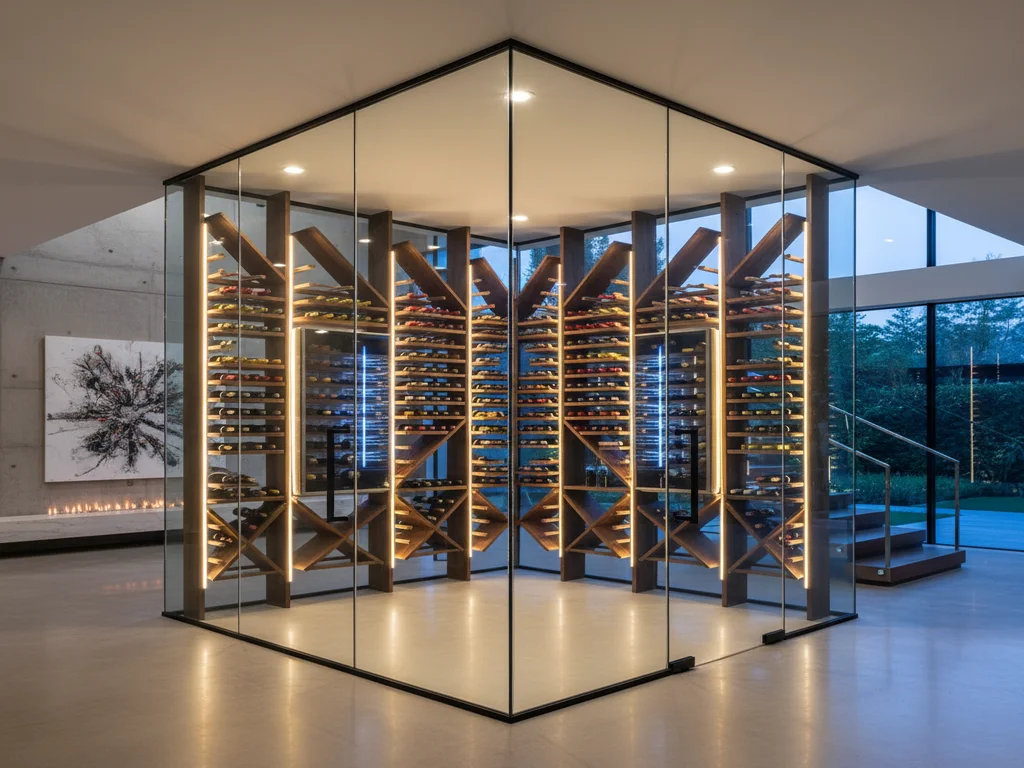
Racking defines both capacity and character. Custom wood racking—often in stable, attractive species—lets you mix storage types to match how you actually collect: standard horizontal rows for the bulk of the cellar, angled or cubed bins for case storage, and dedicated rows for large-format and oddly shaped bottles. Display rows that show the label face-out turn prized bottles into focal points.
Plan racking around real questions
- How many bottles today, and how many in ten years? (Build in growth.)
- What do you collect—mostly Bordeaux-style bottles, or lots of large formats and odd shapes?
- Do you want a tasting or service counter, and storage for glasses and tools?
- Which bottles deserve display, and which are working inventory?
The defining luxury trend
The Glass Enclosure: Cellar as Architecture
The most dramatic shift in recent years is bringing the cellar out of the basement and into view. Glass-enclosed wine rooms and floor-to-ceiling “wine walls” let a collection become living architecture—visible from the dining room, framing an entry, or anchoring a great room. It’s spectacular, but it raises the engineering stakes: glass is a poor insulator, so a glass-walled wine room demands proper insulated glazing, sealed construction, and a correctly sized cooling system to stay stable.
A wine wall—a shallower, display-forward installation—is a compelling option when a full room isn’t practical. It delivers much of the visual drama within a slim footprint and integrates naturally into open-plan living spaces.
Beauty without heat
Lighting and Materials
Lighting makes or breaks the room, with one rule above all: keep heat and UV away from the wine. Low-heat LED lighting is the standard—accent lighting that grazes the racking, subtle label illumination on display rows, and indirect glows that make the space feel like a jewel box. Materials should suit a humid, cool environment: moisture-tolerant woods, stone, and finishes chosen to live happily in those conditions for the long term. Reclaimed and richly toned woods are popular for the warmth and sense of age they bring.
Placement shapes the whole project
Where to Put It
Wine rooms succeed in many locations: under a staircase as a jewel-box display, off the dining room for effortless service, in a converted closet or pantry, or as a dedicated room in a lower level. The right spot balances three things—proximity to where you entertain, the ease of insulating and cooling that location, and the visual impact you want. An under-stair installation can be every bit as stunning as a grand cellar when it’s designed with intention.
Engineering and craft, designed as one
Bringing It Together
The throughline of every great wine room is that the technical and the beautiful are designed together, not bolted on to each other afterward. The cooling, the envelope, the racking, the glass, and the lighting all influence one another. Designed as a single system—by people who build custom millwork and understand how these rooms actually perform—the result protects your collection for decades and gives your home a feature people remember long after the last glass.
Explore
Design Your Wine Room
Frequently Asked Questions
- What temperature and humidity should a wine room be?
- Fine wine is generally stored around the mid-50s Fahrenheit with relatively high, stable humidity of roughly 60 to 70%. Consistency matters as much as the numbers — swings in temperature are more damaging than a steady temperature slightly off ideal — which is why a true wine room needs a dedicated cooling system sized for the space, not a household thermostat.
- Does a wine room need special insulation and a vapor barrier?
- Yes. A wine room is fundamentally a building-envelope project before it is a decorating one: the room must be properly insulated, sealed with a vapor barrier, and fitted with the right door and glazing. Otherwise the cooling system fights the house all day and humidity collects where it should not — so the envelope and cooling should be planned first, with the design built within those constraints.
- Can a wine room have glass walls and still stay cold?
- Glass-enclosed wine rooms and floor-to-ceiling wine walls are the defining luxury trend, letting a collection become visible architecture from a dining or great room. But glass is a poor insulator, so a glass-walled wine room demands proper insulated glazing, sealed construction, and a correctly sized cooling system to stay stable. A shallower display-forward wine wall is a compelling option when a full room is not practical.
- What lighting is safe for a wine room?
- The one rule above all is to keep heat and UV away from the wine, so low-heat LED lighting is the standard — accent lighting that grazes the racking, subtle label illumination on display rows, and indirect glows that make the space feel like a jewel box. Materials should likewise suit the cool, humid environment: moisture-tolerant woods, stone, and finishes chosen for those conditions.
- Where is the best place to put a wine room in a house?
- Wine rooms succeed in many locations: under a staircase as a jewel-box display, off the dining room for effortless service, in a converted closet or pantry, or as a dedicated room in a lower level. The right spot balances proximity to where you entertain, the ease of insulating and cooling that location, and the visual impact you want.
Continue Reading
Related Guides
More in This Guide
Related Reading
Continue Learning
Planning a kitchen and want to talk it through with the person who will build it?
Request a Design Consultation