Fairgrove Eichlers, Monta Vista ranches and Rancho Rinconada split-levels
Remodeling Cupertino Kitchens That Outlived Their Floor Plans
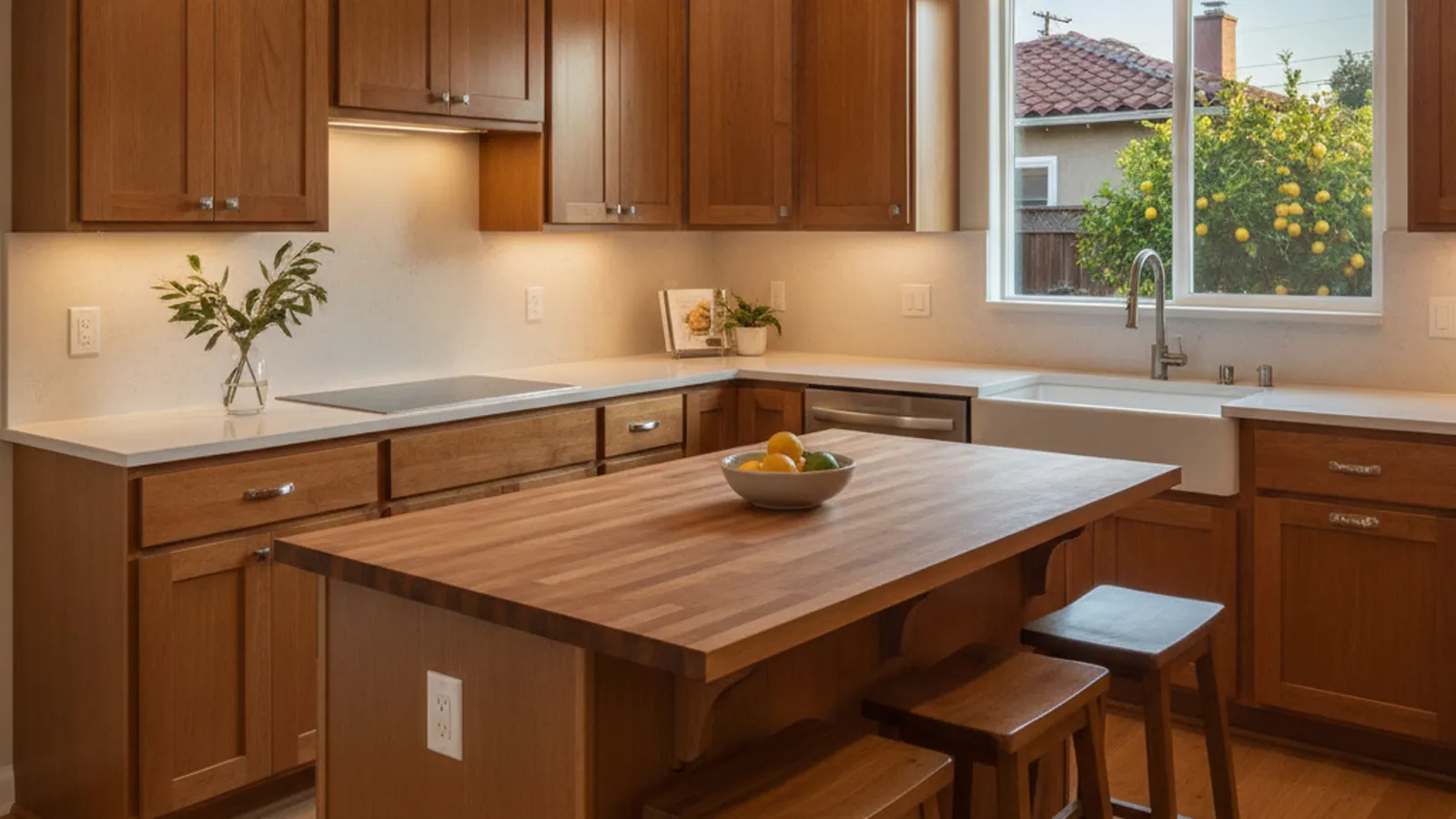
Cupertino's housing stock was built fast in the orchard-to-suburb decades, and most of its kitchens were never meant to last this long. We remodel them properly, working with the realities of mid-century framing, original galley layouts, and walls that hide a half-century of revisions.
Remodeling Cupertino Kitchens That Have Outlived Their Original Plans
Cupertino grew up almost overnight. The apricot and prune orchards that once covered the flatlands below Stevens Creek were subdivided through the 1950s and 1960s, and most of the city's homes date from that single building wave: Eichlers in the Fairgrove tract off Bollinger, ranch houses in Monta Vista climbing toward the foothills, and split-levels and tract ranches filling Rancho Rinconada east of Wolfe. Sixty years later, those kitchens are still in service, and they were never designed for the way people cook and gather today. Remodeling them is the work we do here, and it is a different discipline from building new. Since 2006, PineWood Cabinets has approached Cupertino remodels as a problem of working honestly with what already exists.
A kitchen remodel in this city is rarely a blank slate. Behind the drywall of a Rancho Rinconada ranch you find post-and-beam framing, undersized electrical service, galvanized supply lines that have outlived their warranty by decades, and the ghosts of one or two earlier renovations done by previous owners. An Eichler in Fairgrove brings its own puzzle: slab-on-grade floors with radiant heat tubing you cannot cut into casually, exposed beam ceilings that won't hide ductwork, and the famous floor-to-ceiling glass that leaves almost no upper-cabinet wall to work with. We plan around these constraints rather than pretending they are not there, because the homeowners who call us have usually already learned the hard way that a remodel here is mostly about what the house will and will not allow.
Many of the homes we remodel here belong to households who settled in Cupertino for the Cupertino Union and Fremont Union school districts and a central spot among De Anza College and the surrounding employers. They are not looking to flip; they have decided to stay, and they want a kitchen that finally fits the house they have committed to. That long-term outlook shapes everything we recommend, because a remodel built to last fifteen years asks for different decisions than one staged for a quick sale.
How We Approach a Cupertino Kitchen Renovation
Every project below is framed around the renovation realities of Cupertino's mid-century housing, not a generic showroom layout.
Opening Up Closed Galley Kitchens
Most original Cupertino ranches put the kitchen in a small, walled-off room. We assess which partitions are load-bearing, plan beam work with your structural engineer, and rebuild storage around the new open sightline to the living areas.
- Load-bearing wall assessment
- Cabinetry redesigned for an open plan
- Peninsula and island integration
- Coordinated finish transitions
Eichler-Sensitive Remodels
Fairgrove Eichlers reward a light touch. We design low-profile cabinetry that respects the post-and-beam lines, avoids cutting into radiant slabs, and keeps the connection to the glass walls and atrium intact.
- Slab and radiant-tubing awareness
- Beam-ceiling clearance planning
- Frameless, horizontal-grain casework
- Storage that preserves the glass walls
Whole-Kitchen Reconfiguration
When the existing footprint simply does not work, we relocate the sink, range, and refrigerator into a layout that fits how you actually cook, coordinating with plumbing and electrical trades from the first measurement.
- Plumbing and electrical relocation
- Updated panel and circuit planning
- New cabinet runs to suit the layout
- Permit-ready drawings for the city
Cabinetry Built for the New Space
Our cabinetry is built to order rather than pulled from stock, so it fits the irregular walls and out-of-square corners that older Cupertino homes always reveal once the demolition starts.
- Custom dimensions for old framing
- Dovetailed drawer boxes
- Full-extension soft-close hardware
- Interior storage fitted to your tools
Updating Systems Behind the Walls
A remodel is the moment to address what the cabinets will hide for the next two decades. We coordinate the upgrade of aging wiring, supply lines, and ventilation while the walls are open.
- Electrical service coordination
- Supply-line replacement timing
- Range hood and make-up air planning
- Insulation and moisture detailing
Finish & Material Selection
We help you choose surfaces, hardware, and door styles that suit both the era of your home and the way light moves through it, from the bright glass of an Eichler to the deeper ranch interiors of Monta Vista.
- Door and panel style guidance
- Countertop and backsplash pairing
- Hardware and fixture coordination
- Light-aware finish selection
How a Cupertino Remodel Comes Together
A renovation has more moving parts than a fresh build. Our process is sequenced to keep the surprises that older homes hold from becoming setbacks.
Site Assessment
We walk your Cupertino home, measure the existing kitchen, and look closely at framing, slab type, and the condition of the systems hidden behind it before any design begins.
Design & Permitting
We develop a layout suited to your house and produce the drawings the City of Cupertino requires, coordinating with structural and trade partners where walls or systems move.
Demolition & Discovery
Demolition is where older homes reveal their secrets. We open the space, confirm conditions, and adjust the plan for anything the original builders left behind.
Build & Installation
Your custom cabinetry is fabricated and installed, trades are sequenced, and we manage the work through to the final fit, finish, and walkthrough.
Why Cupertino Kitchens Reward a Careful Remodel
Cupertino sits at the southwest edge of the Santa Clara Valley, where the flatlands tilt up into the foothills below Stevens Creek and Rancho San Antonio. That geography sorted the city into distinct kinds of homes, and each asks for a different remodeling instinct. The Monta Vista neighborhood, the oldest part of town near the old quarry road and McClellan, holds ranch homes on larger, sloping lots where additions and reconfigured kitchens are common. Down on the flats, Rancho Rinconada's tightly packed 1950s tract houses ask for clever space-planning within a fixed footprint.
Then there is Fairgrove, the protected Eichler enclave off Bollinger Road, where remodels are governed as much by respect for the original architecture as by code. A kitchen there cannot simply be ripped out and replaced with whatever is in fashion; the post-and-beam roofline, the glass walls, and the slab radiant heat all set hard limits. Homeowners who love these houses want a remodel that reads as if it had always been there, and that is exactly the kind of restraint we bring.
Property values along streets like Stelling, Bubb, and Foothill mean a remodel here is a serious investment, and homeowners are right to want it done by people who understand the local housing stock rather than treating every kitchen the same. We have spent years working in the homes between De Anza Boulevard and the foothills, and that familiarity is what lets us plan a renovation with fewer surprises and a result built to outlast the next owner.
Mid-Century Framing, Handled Honestly
Post-and-beam and slab construction set real limits on where walls, ducts, and plumbing can go. We plan within them instead of fighting them.
Neighborhood-Specific Layouts
A Fairgrove Eichler, a Monta Vista ranch, and a Rancho Rinconada tract house each get a layout suited to its bones, not a copied template.
Built to Stay
Our Cupertino clients are settling in for the long term. We build cabinetry and plan renovations meant to serve for decades, not a single sale cycle.
Cupertino Kitchen Remodeling Questions
Honest answers to what Cupertino homeowners most often ask before starting a renovation.
Can we remodel the kitchen in our Fairgrove Eichler without harming the architecture?
Yes, and that restraint is central to how we work in Fairgrove. We design cabinetry that respects the post-and-beam ceiling and the glass walls, avoid cutting into the radiant slab where possible, and keep the open connection that defines an Eichler. The goal is a kitchen that reads as a natural part of the house rather than an imposition on it.
Will I need permits from the City of Cupertino?
Most kitchen renovations that move walls or alter electrical and plumbing require permits from the City of Cupertino. We prepare permit-ready drawings and coordinate with the relevant trades so the work is documented and inspected correctly, which matters in a city where homes are held and resold with this paperwork in mind.
Our ranch home in Monta Vista has a closed-off kitchen. Can it be opened up?
Often, yes. Many Monta Vista ranches were built with walled galley kitchens, and removing a partition can transform the space. The first step is determining whether the wall is load-bearing, which usually involves a structural engineer and a beam to carry the load. Once that is settled, we design the new cabinetry and storage around the open sightline.
Why do remodels in older Cupertino homes sometimes change once work begins?
Homes from the orchard-subdivision era frequently hide aging wiring, dated plumbing, and earlier renovations that only become visible during demolition. We assess as thoroughly as we can beforehand, but we also build flexibility into the plan so that genuine discoveries can be handled without derailing the project.
Explore More Cupertino & Silicon Valley Services
A kitchen remodel is one of several ways we work in Cupertino. Explore our related services and the nearby communities we serve across Silicon Valley.

Let’s Begin
Ready to Remodel Your Cupertino Kitchen?
Tell us about your home, whether it is a Fairgrove Eichler, a Monta Vista ranch, or a Rancho Rinconada tract house, and we will help you plan a renovation that works with its bones. Custom cabinetry, crafted since 2006.
Explore