Design Insights
Anatomy of a Standout Kitchen Design
A design study illustrating how PineWood Cabinets approaches a standout custom kitchen, from fumed oak to layered lighting.
A Design Study in How a Project of This Kind Comes Together
Anatomy of a Standout Kitchen
Every project we undertake at PineWood Cabinets is built to the same exacting standards, but it helps to see how those standards play out across an entire room. This design study walks through a representative project -- a kitchen of the kind we are often asked to create -- to illustrate our approach. The point is not extravagance, but that every decision, from wood selection to hinge placement, can serve a clear purpose.
Picture a complete kitchen renovation in a 1960s-era home in a community like Hillsborough, California. Homeowners who entertain frequently and cook seriously might want a kitchen that honors the home's mid-century architectural roots while incorporating modern functionality. The existing kitchen is dated, poorly lit, and chopped into three small rooms. The goal is to create one cohesive space that feels both timeless and contemporary.
What makes a project of this kind stand out is rarely any single dramatic gesture. It is the accumulation of hundreds of small, deliberate choices that add up to something extraordinary. Here is how a project like this can come together.
The Design Vision
A brief like this typically asks for warmth without heaviness, modern lines without sterility, and professional-grade function without an industrial feel. These seemingly contradictory goals make for a rich creative challenge. For a project of this kind we would develop a palette centered on fumed white oak -- a species that darkens naturally through an ammonia fuming process, creating rich amber tones with extraordinary depth that no stain can replicate.
The layout would remove the wall between the kitchen and a small breakfast room, creating a single 480-square-foot space anchored by a 12-foot island, while preserving the wall to the formal dining room and adding a wide cased opening with integrated display shelving that allows visual connection without full exposure. Opening the ceiling to reveal an original post-and-beam structure, restored with a warm oil finish, complements the cabinetry below.
Cabinetry Details That Make the Difference
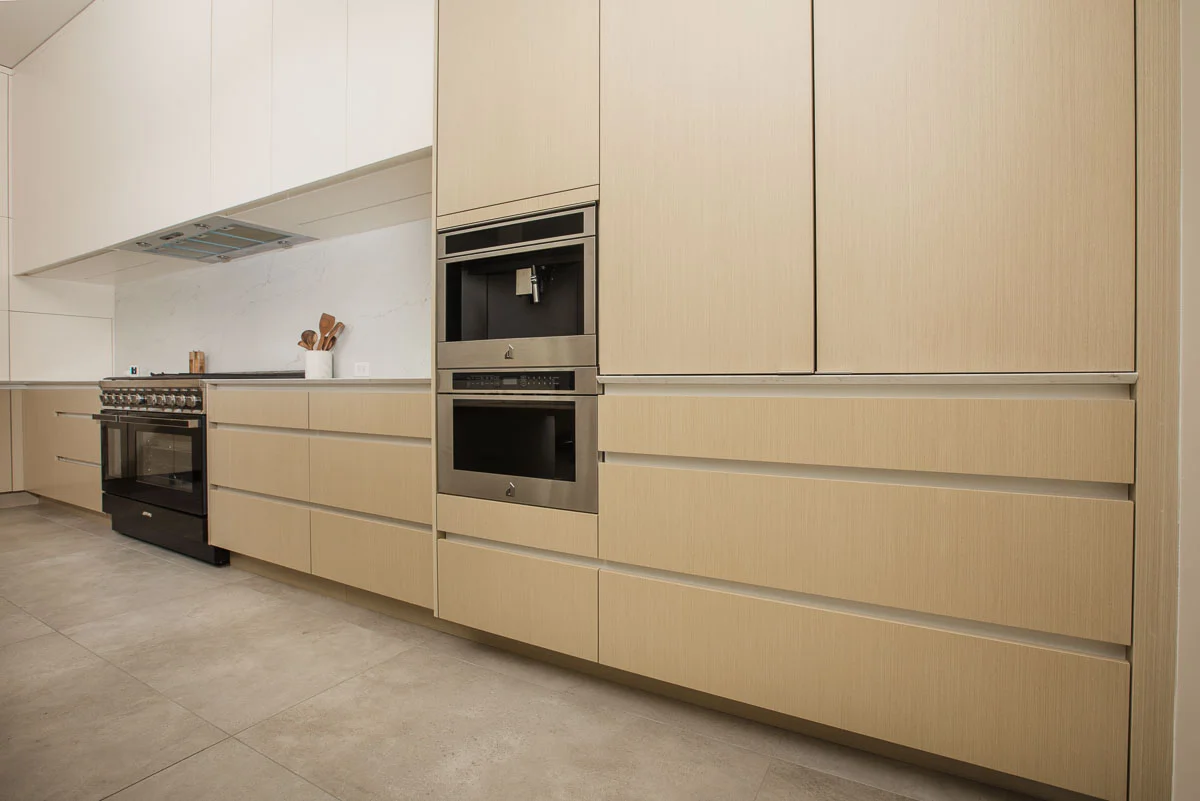
The perimeter cabinetry would use flat-panel doors in fumed white oak with a hand-applied hardwax oil finish by Rubio Monocoat. This finish penetrates the wood fibers rather than sitting on the surface like lacquer, allowing the grain texture to be felt under the fingertips. Every door and drawer front is grain-matched sequentially, meaning the wood grain flows continuously from one cabinet to the next as though cut from a single plank.
The island base, by contrast, takes a hand-troweled Venetian plaster finish in a warm putty tone, creating a visual anchor that reads as furniture rather than cabinetry. The island countertop is a single slab of Taj Mahal quartzite -- a Brazilian stone with soft gold veining that echoes the fumed oak tones. At 12 feet long, sourcing a single unbroken slab means coordinating directly with the stone fabricator months in advance.
Hardware stays minimal. Recessed pulls such as Linnea's in a brushed stainless finish are barely visible, letting the wood and stone speak, with concealed self-closing Blum Clip Top Blumotion hinges throughout. Appliance panels for the refrigerator and dishwasher, fabricated from the same sequential grain-matched oak, make the appliances essentially invisible.
Functional Innovation
For accomplished cooks who want professional functionality without professional aesthetics, we might specify a Wolf 48-inch dual-fuel range with a custom ventilation hood clad in the same fumed oak as the cabinets -- a detail that required close collaboration with our sheet metal fabricator to ensure proper clearances while maintaining the wood exterior. The interior of the hood is stainless steel with baffle filters rated for high-heat cooking.
Behind a pocket door to the right of the range sits a complete prep kitchen with a second dishwasher, a commercial-depth stainless steel sink, open shelving for everyday dishes, and a speed oven for quick reheating. This allows the main kitchen to stay pristine during dinner parties while all the real work happens steps away. The prep kitchen cabinetry is the same species in a simpler slab door, keeping costs reasonable while maintaining material continuity.
Lighting and Atmosphere
Lighting is designed in layers, as it should be in any great kitchen. Recessed LED downlights on dimmers provide ambient illumination. Under-cabinet LED strips in a warm 2700K tone wash the countertops for task lighting. Pendant fixtures over the island -- hand-blown glass is a natural choice -- add sculptural interest and focused light for dining. Interior cabinet lighting on glass-front uppers creates a soft glow in the evening that transforms the kitchen into the most inviting room in the house.
A tunable lighting system such as Ketra's allows the homeowners to shift color temperature throughout the day -- cooler and brighter for morning meal prep, warmer and dimmer for evening entertaining. This technology, integrated into the home automation system, ensures the cabinetry and stone always look their best regardless of the time of day.
Lessons From a Project Like This
A project like this reinforces several principles that guide our work at PineWood Cabinets. First, restraint is powerful. Rather than introducing multiple species, finishes, and materials, limit the palette and let quality speak. Second, the hidden spaces matter as much as the visible ones. The prep kitchen, the interior of every drawer, the underside of the island -- every surface deserves to be finished with care. Third, collaboration between designer, craftsman, and homeowner produces results that none could achieve alone.
A kitchen built this way is designed to be loved as much years later as on the day it is installed. Fumed oak mellows beautifully over time, quality hardware keeps operating smoothly, and a well-considered layout continues to support daily life exactly as intended. For us, that lasting livability -- not any accolade -- is the true measure of success.
To see more of our work, visit our portfolio, or contact us to discuss your own project.
Continue exploring kitchen design excellence
Related Articles
Frequently Asked Questions
- What makes a custom kitchen design stand out?
- A standout kitchen is rarely the result of any single dramatic gesture — it is the accumulation of hundreds of small, deliberate choices, from wood selection to hinge placement, each serving a clear purpose. Restraint is powerful: limiting the palette and letting material quality speak tends to produce stronger results than layering multiple species and finishes. Hidden spaces matter as much as visible ones, so the interior of every drawer and every concealed surface deserves the same care.
- What is fumed white oak?
- Fumed white oak is oak that darkens naturally through an ammonia fuming process, creating rich amber tones with extraordinary depth that no stain can replicate. It also mellows beautifully over time, which makes it well suited to a kitchen intended to be loved as much years later as on installation day.
- What is sequential grain matching in cabinetry?
- Sequential grain matching means every door and drawer front is cut and arranged so the wood grain flows continuously from one cabinet to the next, as though the entire run were cut from a single plank. The same grain-matched material can be used for appliance panels on a panel-ready refrigerator or dishwasher, making the appliances essentially invisible within the cabinetry.
- What is a prep kitchen and why include one?
- A prep kitchen is a secondary work space tucked behind a pocket door off the main kitchen, equipped with items like a second dishwasher, a commercial-depth stainless steel sink, open shelving for everyday dishes, and a speed oven for quick reheating. It lets the main kitchen stay pristine during dinner parties while the real work happens steps away, and using the same wood species in a simpler slab door keeps costs reasonable while maintaining material continuity.
- How should lighting be layered in a kitchen?
- Great kitchen lighting works in layers: recessed LED downlights on dimmers for ambient illumination, under-cabinet LED strips in a warm 2700K tone for task lighting on countertops, pendant fixtures over the island for sculptural interest and focused light, and interior cabinet lighting on glass-front uppers for a soft evening glow. A tunable system can shift color temperature through the day — cooler and brighter for morning prep, warmer and dimmer for evening entertaining.
Continue Reading
Related Guides
More in This Guide
Related Reading
Continue Learning
Planning a kitchen and want to talk it through with the person who will build it?
Request a Design Consultation