Cost Guide | Published February 18, 2026
Custom Cabinet Cost Breakdown: What Actually Drives the Price
Not a price list—a breakdown of the decisions that make custom cabinetry cost what it does, so you can spend where it matters.
Two custom kitchens can be the same size and look superficially similar, yet one costs twice the other. That gap confuses homeowners, and it’s where a lot of frustration—and a few bad decisions—come from. The truth is that custom cabinet pricing isn’t arbitrary. It’s the sum of a series of specific choices, most of them invisible in a photograph. This is a breakdown of those choices, so you understand what you’re actually paying for and can direct your budget toward the things that matter to you.
This article explains the drivers of cost rather than quoting dollar figures—for realistic dollar ranges, see our companion guides linked at the end.
The foundation of the price
1. Materials: The Box and the Wood
Cost starts with what the cabinet is made of. The box itself can be furniture-grade plywood or, at the lower end, particleboard or MDF—plywood costs more and holds fasteners and weight better over decades. Then there’s the species of the visible wood: paint-grade maple or poplar sits at one end; walnut, rift-sawn white oak, and figured or exotic species at the other, sometimes at several times the price. Solid wood doors cost more than veneered panels, and the grade and yield of the lumber (how much gets discarded to achieve consistent grain) quietly drives the number.
Joinery you'll never see, but always feel
2. Construction Method
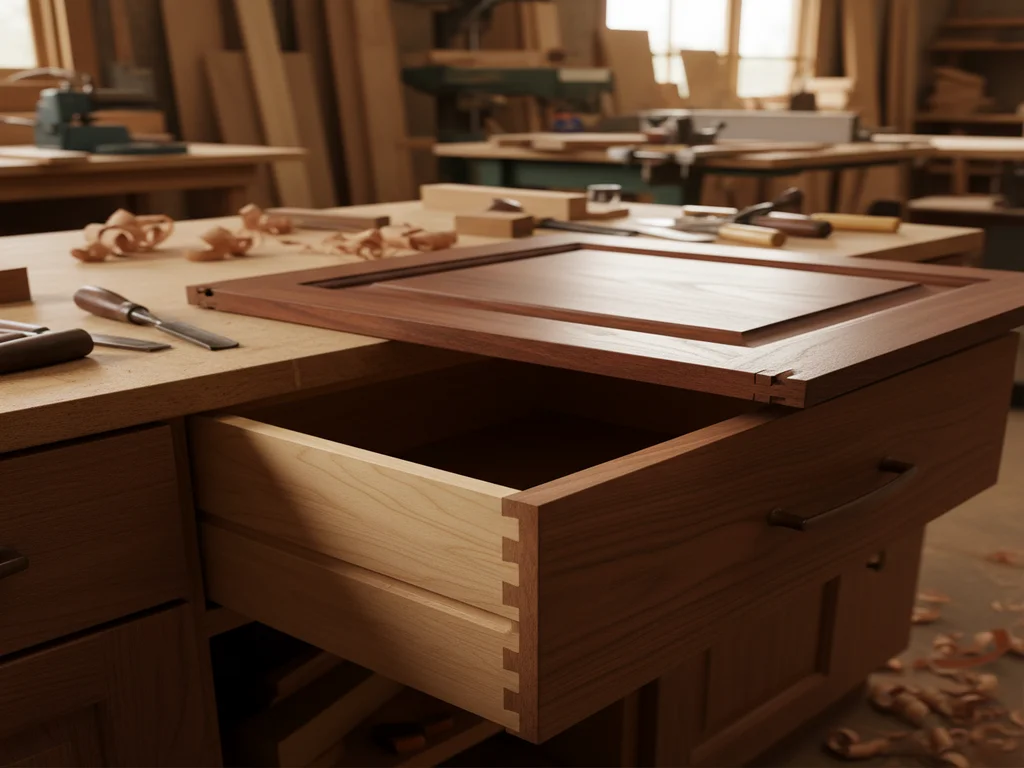
How the pieces go together is a major cost lever. Dovetailed solid-wood drawer boxes, mortise-and-tenon doors, full-thickness backs, and dado joinery all take more time and skill than stapled butt joints and thin panels—and they’re the difference between cabinetry that lasts a generation and cabinetry that loosens in a decade. Inset construction, where each door is fitted precisely inside a face frame, is meaningfully more labor-intensive than overlay or frameless, which is why it carries a premium.
Often underestimated, frequently decisive
3. Finish
Finishing is one of the most underestimated cost drivers. A simple stained-and-sealed natural wood is far less labor than a multi-step painted finish, where every surface is sanded, primed, sprayed, and sanded again between coats to achieve a glass-smooth result. Specialty finishes—glazes, distressing, cerused or limed oak, hand-rubbed oils, or color-matched custom paints—add hours per piece. The finish is also where quality is most visible up close, so it’s rarely the place to economize on a luxury kitchen.
Every special detail is real labor
4. Complexity and Customization
The features that make a kitchen feel bespoke each carry a cost because each is built by hand:
- Furniture-style details, applied moldings, and integrated range hoods
- Curved, angled, or non-standard cabinet shapes
- Specialty interiors: spice pull-outs, appliance garages, custom inserts
- Grain-matched runs and book-matched panels
- Tall, oversized, or floor-to-ceiling cabinetry
A perfectly rectangular kitchen with standard heights is far less expensive to build than one full of one-off details—even at the same square footage.
The pieces that do the work
5. Hardware
Hinges and drawer slides are functional hardware, and the quality range is enormous. Premium soft-close, full-extension, concealed systems cost several times more than basic builder hardware—and they’re what make a drawer glide and a door close with a satisfying, quiet thunk for twenty years. Decorative hardware (knobs and pulls) is a separate budget line that can range from modest to surprisingly significant across a large kitchen.
Skill, time, and accountability
6. Labor and Shop Overhead
Finally, custom cabinetry is fundamentally a labor product. You’re paying for skilled craftspeople, design and shop-drawing time, precise installation, and the overhead of a real shop standing behind the work. A genuinely custom shop measures your space, builds to it, and is accountable for the result—different from ordering modular boxes and hoping they fit. That accountability is part of what your price buys.
Spend on what you'll feel every day
How to Use This When You Budget
Once you see cost as a stack of choices rather than a single number, you can shape it intelligently. The smartest moves are usually to invest in the things you touch and that last—solid construction, quality drawer hardware, a durable finish—and to be selective about the elements that mainly add expense without changing daily life. A good cabinetmaker will happily walk you through these trade-offs line by line; that transparency is a sign you’re working with the right shop.
Explore
Plan Your Custom Cabinetry
Related Reading
Trusted Resources
Frequently Asked Questions
- What drives the cost of custom cabinets?
- Custom cabinet pricing is the sum of a series of specific choices rather than a single arbitrary number: the materials (the cabinet box and the visible wood species), the construction method and joinery, the finish, the level of complexity and customization, the hardware, and the labor and shop overhead behind the work. Most of these choices are invisible in a photograph, which is why two similar-looking kitchens can be priced very differently.
- Why do two custom kitchens of the same size cost such different amounts?
- Two custom kitchens can be the same size and look superficially similar, yet one costs twice the other, because the cost drivers are largely invisible: furniture-grade plywood boxes versus particleboard or MDF, paint-grade maple or poplar versus walnut or rift-sawn white oak (sometimes at several times the price), dovetailed drawer boxes versus stapled butt joints, and the number of one-off details. A perfectly rectangular kitchen with standard heights is far less expensive to build than one full of custom details, even at the same square footage.
- Does inset cabinetry cost more than frameless or overlay?
- Yes. Inset construction, where each door is fitted precisely inside a face frame, is meaningfully more labor-intensive than overlay or frameless construction, which is why it carries a premium.
- Is a painted cabinet finish more expensive than a stained one?
- Yes. A simple stained-and-sealed natural wood finish is far less labor than a multi-step painted finish, where every surface is sanded, primed, sprayed, and sanded again between coats to achieve a glass-smooth result. Specialty finishes such as glazes, distressing, cerused or limed oak, hand-rubbed oils, and color-matched custom paints add hours per piece.
- Where should you spend and where should you save on custom cabinetry?
- The smartest moves are usually to invest in the things you touch and that last — solid construction, quality drawer hardware, and a durable finish — and to be selective about elements that mainly add expense without changing daily life. A good cabinetmaker will walk you through these trade-offs line by line, and that transparency is a sign you are working with the right shop.
Continue Reading
Related Guides
More in This Guide
Related Reading
Continue Learning
Planning a kitchen and want to talk it through with the person who will build it?
Request a Design Consultation