Design Insights
Kitchen Design Trends 2026: What California Elite Are Choosing
Discover the latest kitchen design trends 2026: what california elite are choosing shaping luxury kitchen design in California's most prestigious homes.
Defining Trends from the State's Most Prestigious Kitchen Projects
What California's Elite Are Choosing in 2026
California's luxury kitchen landscape in 2026 reflects a profound shift in how the state's most discerning homeowners think about their living spaces. The all-white, sterile kitchens that defined the 2010s have given way to spaces rich with warmth, texture, and personality. Across our projects—from Atherton tech estates to Montecito hillside retreats—we are seeing clients make bolder, more informed, and more personal choices than ever before.
What distinguishes 2026 is not a single dominant trend but rather a convergence of several powerful movements. Clients want natural materials with visible grain and texture. They want technology that works invisibly. They want sustainability without sacrificing luxury. And they want kitchens that tell a story—spaces with provenance, character, and a sense of place that connects them to California's extraordinary landscapes and cultural heritage.
These insights reflect what California clients at the high end of the market are actually asking for in design consultations—not speculative forecasts from trade shows, but the direction of real briefs at the $200,000-and-up level.
Warm Wood Dominance: The Post-White Kitchen Era
The most significant trend of 2026 is the decisive move toward natural wood cabinetry. Rift-sawn white oak leads the demand, prized for its straight, consistent grain pattern that reads as sophisticated rather than rustic. We are finishing it in everything from pale honey tones to deep, smoky amber, and increasingly in cerused (limed) finishes where white pigment is rubbed into the open grain to create a subtle, textured effect that photographs beautifully and feels extraordinary to the touch.
Walnut remains the premier choice for clients seeking drama and warmth. American black walnut, with its chocolate-to-purple heartwood and golden sapwood, makes a stunning statement particularly on island cabinetry. We are also seeing growing interest in European walnut, which tends toward a lighter, more uniform tone with less dramatic color variation. For projects where budget allows, we have sourced claro walnut—a California native species with extraordinary figured grain—for truly one-of-a-kind installations.
The preference for natural wood extends beyond cabinetry faces to include visible interior boxes in maple or birch, wood-lined drawers, and open shelving in matching species. Clients want the warmth of wood to be pervasive, not just surface-deep. This pairs beautifully with our hand-applied finishing techniques that enhance rather than mask the wood's natural character.
The Fluted and Reeded Cabinet Door
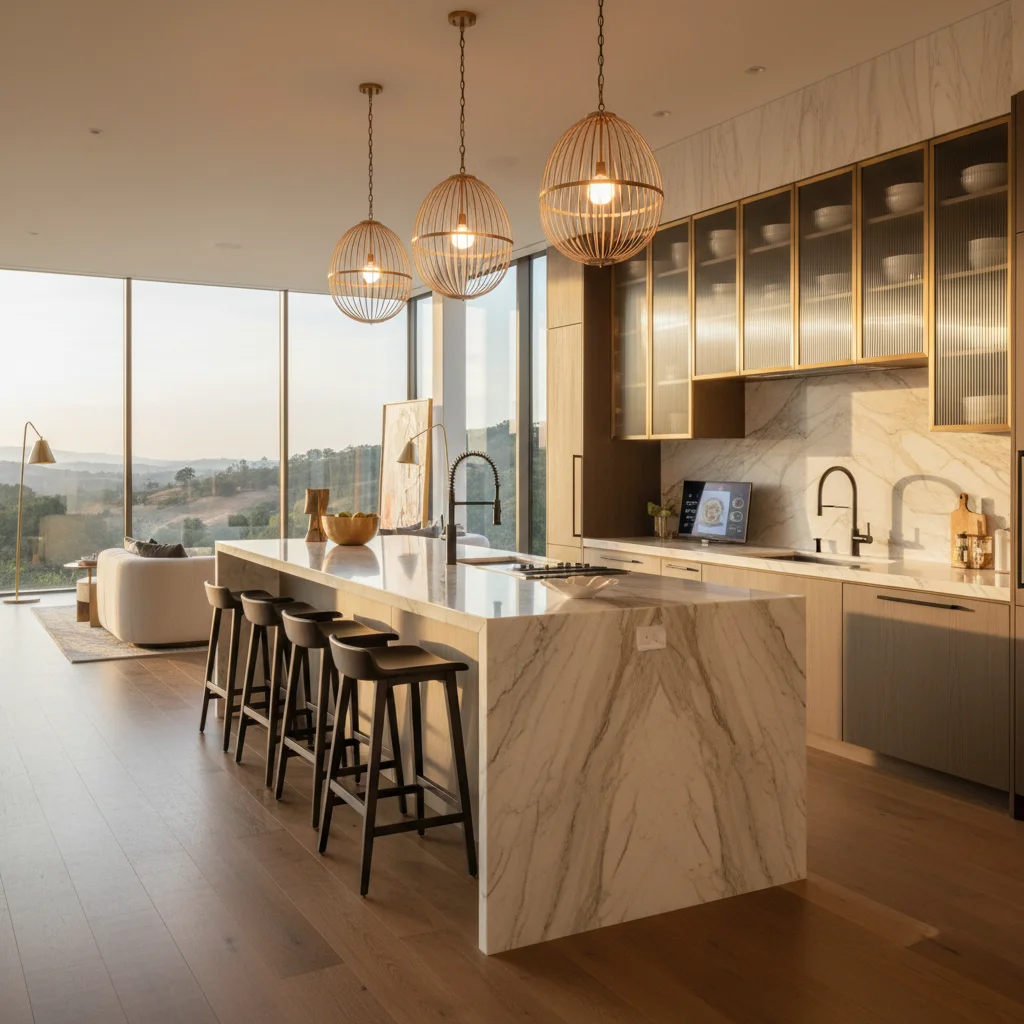
Textured cabinet doors have become the definitive design detail of 2026. Fluted doors—featuring evenly spaced vertical channels carved into the surface—add dimension and visual interest to flat-panel designs without the ornate complexity of traditional raised-panel styles. We machine our flutes on a CNC router with custom tooling that produces perfectly consistent channels, typically 12mm to 18mm wide with a half-round profile.
Reeded doors offer a similar effect with a more refined, tighter pattern—narrower grooves spaced closer together. Both styles work exceptionally well in rift-sawn white oak, where the linear grain of the wood reinforces the vertical pattern of the fluting. We use fluted panels most often on island end panels, tall pantry doors, and appliance panels, where they create a furniture-like quality that elevates the entire kitchen. For a contrasting approach, see our piece on minimalist kitchen design.
Integrated Appliances: The Invisible Kitchen
Panel-ready appliances have evolved from a luxury option to a baseline expectation in high-end California kitchens. In 2026, the push toward full integration has intensified. Sub-Zero's Designer Series columns, Miele's PureLine built-in range, and Gaggenau's Vario 400 series all offer flush-mount installations that completely disappear behind custom cabinetry panels. The goal is a kitchen where you genuinely cannot tell which door hides the refrigerator and which opens to a pantry.
Beyond standard panel integration, we are building increasingly sophisticated concealment systems. Motorized pocket doors that slide open to reveal a full breakfast station—toaster, coffee machine, and outlets—then close seamlessly. Appliance towers where ovens, steam ovens, and warming drawers stack behind a single tall door system. Even range hoods concealed within custom millwork soffits that appear as architectural ceiling details rather than kitchen equipment.
Bold Stone Statements
Countertop selections in 2026 lean toward the dramatic. Bookmatched quartzite slabs with sweeping veins of gold and gray, full-height backsplashes in Calacatta marble that extend from counter to ceiling, and waterfall island edges that showcase the stone's natural drama—these are standard requests rather than exceptional ones. The stone is treated as the kitchen's artwork, with cabinetry intentionally understated to let it shine.
Leathered and honed finishes continue to gain ground over polished stone. The matte texture hides fingerprints and water spots better than polished surfaces, making these finishes both more practical and more aesthetically aligned with the warm, textured mood of current design. Taj Mahal quartzite with a leathered finish has become one of our most-specified stones, offering marble-like beauty with significantly better durability. Explore the full range of options in our guide to natural stone applications.
Sustainability as Standard
Environmental consciousness has moved from differentiator to default in California luxury design. In 2026, our clients expect FSC-certified wood sourcing, zero-VOC finishes, and responsible manufacturing practices as givens, not selling points. Many are going further—requesting carbon-neutral cabinetry, cradle-to-grave material provenance documentation, and locally sourced materials that support California's forestry and manufacturing sectors.
We have responded by deepening our relationships with domestic sawmills, investing in low-emission finishing systems, and partnering with reclaimed wood suppliers who salvage old-growth timber from deconstructed buildings. The result is cabinetry that is both environmentally responsible and often more characterful than new-growth alternatives. A kitchen built from 150-year-old reclaimed Douglas fir has a depth of color and grain density that no modern timber can replicate. Learn about our sustainable luxury approach.
The trends of 2026 point toward a kitchen that is warmer, more personal, more technologically sophisticated, and more environmentally conscious than anything that has come before. California continues to lead the nation in defining what luxury means in the kitchen, and we are proud to be at the forefront of that evolution. Schedule a design consultation to explore how these trends can inform your project.
Continue exploring kitchen design excellence
Related Articles
Frequently Asked Questions
- What is the biggest kitchen design trend in California luxury homes for 2026?
- The most significant trend of 2026 is the decisive move toward natural wood cabinetry, marking a post-white-kitchen era. Rift-sawn white oak leads the demand for its straight, consistent grain, finished in everything from pale honey tones to deep smoky amber and increasingly in cerused (limed) finishes, while American black walnut remains the premier choice for drama and warmth, particularly on island cabinetry.
- What are fluted and reeded cabinet doors?
- Fluted doors feature evenly spaced vertical channels carved into the surface — typically 12mm to 18mm wide with a half-round profile — adding dimension to flat-panel designs without the ornate complexity of raised-panel styles. Reeded doors offer a similar effect with narrower grooves spaced closer together. Both work exceptionally well in rift-sawn white oak and are used most often on island end panels, tall pantry doors, and appliance panels.
- What are panel-ready integrated appliances in a luxury kitchen?
- Panel-ready appliances install flush behind custom cabinetry panels so you genuinely cannot tell which door hides the refrigerator and which opens to a pantry — lines like Sub-Zero’s Designer Series columns, Miele’s PureLine built-in range, and Gaggenau’s Vario 400 series support this. In 2026 these have evolved from a luxury option to a baseline expectation in high-end California kitchens, along with concealment systems like motorized pocket doors hiding breakfast stations and range hoods built into millwork soffits.
- What countertop finishes are trending in luxury kitchens in 2026?
- Leathered and honed finishes continue to gain ground over polished stone in 2026, because the matte texture hides fingerprints and water spots better and aligns with the warm, textured mood of current design. Bold stone statements are standard requests — bookmatched quartzite, full-height Calacatta marble backsplashes, and waterfall island edges — and Taj Mahal quartzite with a leathered finish offers marble-like beauty with significantly better durability.
- How does sustainability factor into luxury kitchen design in California?
- In 2026, environmental consciousness has moved from differentiator to default: California luxury clients expect FSC-certified wood sourcing, zero-VOC finishes, and responsible manufacturing as givens. Many go further, requesting carbon-neutral cabinetry, material provenance documentation, and locally sourced or reclaimed materials — a kitchen built from 150-year-old reclaimed Douglas fir has a depth of color and grain density that no modern timber can replicate.
Continue Reading
Related Guides
More in This Guide
Related Reading
Continue Learning
Planning a kitchen and want to talk it through with the person who will build it?
Request a Design Consultation