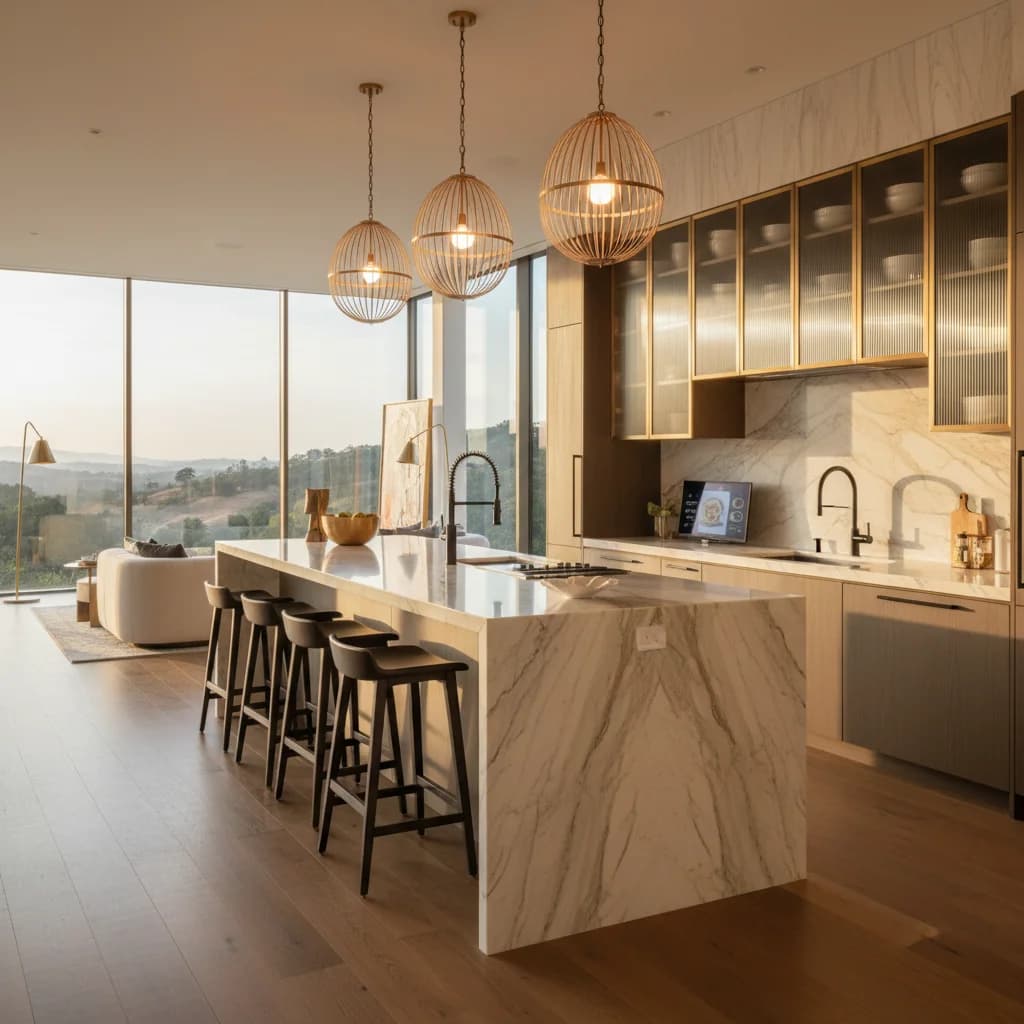
Design Trends | Published October 11, 2025
Kitchen Cabinet Trends 2026: What California Luxury Homeowners Are Choosing
Explore the hottest kitchen cabinet trends for 2026. From color palettes to materials, discover what's defining luxury kitchen design in California's premium homes.
Quick Answer
Which kitchen cabinet trends are worth following?
The directions that hold up are warm neutrals, deep greens and navy used with restraint, natural wood such as rift or quarter-sawn white oak and walnut, satin rather than high-gloss or ultra-matte finishes, concealed appliances, and hardware chosen for feel. Choose for how you cook and live, not for what is popular this year.
For the full guide, see Cabinet Door Styles, which covers Shaker, slab, inset, beaded and glass doors in depth. This post looks at the wider picture: color, finish, hardware and layout directions, and which of them are likely to date.
Kitchen design directions shift quickly, and what looked cutting-edge a short while ago can already look dated. Here are the directions in play right now, and what we would weigh before following any of them.
This isn't your typical "trends" article pulling from Pinterest boards and interior design magazines. It is a cabinetmaker's view of which directions hold up in real use, and which tend to date quickly.
Why Cookie-Cutter Is Finally Dead
The Biggest Trend: Personalization Over Pinterest
Here's the meta-trend that's driving everything else: California luxury homeowners are done with trends. Wait, what? Let me explain.
The "all-white everything" kitchen? Still the right answer in some homes, but only when it truly fits the home and the homeowner. The ultra-modern minimalist aesthetic? Perfect for some clients, completely wrong for others. What's actually trending is intentional design that reflects how you actually live, not what's popular on Instagram.
The better question to bring to a design consultation is not “what’s popular?” but “what would work best for my family, my cooking style and my home’s architecture?”
That said, there are definitely aesthetic directions, materials, and design approaches that are gaining momentum. Here they are.
The Palette Evolution
Color Trends: Beyond Basic White
Color is back. Not screaming, look-at-me color, but sophisticated, nuanced color that adds depth and personality without overwhelming the space.
1. Warm Neutrals
The stark white kitchen is evolving into something warmer, more inviting. Think creamy whites, soft beiges, and warm grays with brown undertones. These aren't your builder-grade beige cabinets from the 90s—these are sophisticated, carefully calibrated neutrals that create a sense of warmth without feeling dated.
Popular Warm Neutral Choices:
- • Greige (Gray + Beige): Benjamin Moore's "Revere Pewter" and Sherwin Williams "Accessible Beige" are common starting points
- • Warm White: Not builder white—think Farrow & Ball "Pointing" or Benjamin Moore "White Dove"
- • Soft Taupe: A natural fit for wine country homes
- • Warm Gray: Benjamin Moore "Classic Gray" is a common starting point
2. Deep, Sophisticated Greens
Forest green, sage, and deep olive bring the California landscape inside, creating kitchens that feel grounded and connected to nature. They suit:
- • Coastal homes: Sage and soft green reminiscent of coastal vegetation
- • Wine country estates: Deep forest green and olive that echo vineyard landscapes
- • Mountain retreats: Rich evergreen tones that bring the outdoors in
3. Navy and Deep Blue Are Here to Stay
Navy kitchen islands have graduated from trend to classic. Navy works as an accent (island only) or in two-tone kitchens, paired with warm whites or natural wood tones. It's sophisticated, timeless, and photographs beautifully—which matters to homeowners whether they admit it or not.
4. Two-Tone Kitchens Are Evolving
Two-tone kitchens aren't new, but how they're executed has moved on. Instead of the stark contrast of white uppers with dark lowers, consider more nuanced approaches:
- • Tonal variations: Light gray perimeter with charcoal island
- • Wood and paint: Natural walnut on lowers, painted uppers
- • Adjacent colors: Sage perimeter with forest green island
- • Material mixing: Painted cabinets with natural wood open shelving
5. Black Cabinets (When Done Right)
All-black kitchens are rare; black works better as an accent. Black lower cabinets with light uppers, black islands, or black pantry doors create dramatic focal points. The key is balance—black needs to be anchored with plenty of natural light, light countertops, and thoughtful lighting design.
An all-black kitchen works best in a room with large windows and strong natural light. Without that, black can make a kitchen feel cave-like.
What's Replacing High-Gloss and Ultra-Matte
Material & Finish Trends
Both ultra-glossy lacquer and flat matte finishes have practical drawbacks. Here’s where we land:
Natural Wood Is Having a Major Moment
Natural wood is back in favor, in a sophisticated, modern way. We're not talking about honey oak from 1995. This is:
- • White oak: Rift-cut or quarter-sawn, with clear or natural finish
- • Walnut: Especially in contemporary and mid-century modern homes
- • Light woods: Maple, ash, and even hickory with natural finishes
- • Cerused oak: Wire-brushed with white filling the grain—stunning texture
Satin and Low-Sheen Finishes
The finish sweet spot right now is low-luster satin—enough sheen to be cleanable and sophisticated, but not so much that every fingerprint shows. This applies to both painted and stained cabinets.
Ultra-matte finishes are beautiful but impractical for working kitchens. They show every fingerprint, splash, and smudge. Satin gives you the best of both worlds.
Textured and Grain-Forward Finishes
Smooth, flat surfaces are giving way to texture. Wire-brushed wood, cerused oak, quartersawn patterns, and even textured paint finishes add depth and interest. These finishes also hide wear better than perfectly smooth surfaces.
Interiors, Textured Panels, and Millwork That Hides the Machines
Warmth That Goes Past the Door Fronts
One direction that does not show up in a color swatch: letting the wood continue past the fronts. Instead of a white melamine interior behind a rift oak door, consider maple or birch veneer interiors, wood-lined drawers, and open shelving in the same species as the doors so the kitchen reads as one material when a cabinet is open. It costs more in shop time, and it is one of the first things people notice when they pull a drawer.
The same thinking drives where fluted and reeded panels actually land. They work best on surfaces you see in full, such as island end panels, tall pantry doors, and appliance panels, where the vertical channels give a run of flat doors a furniture-like depth. Rift-sawn white oak is the natural partner because its straight grain runs with the flutes rather than fighting them. On a busy wall of drawers the texture gets lost, so we steer it toward the few large planes where it can be read. Our door styles guide covers how these textured panels pair with slab and Shaker doors elsewhere in the room.
The other direction the "invisible kitchen" is taking is deeper concealment millwork. Panel-ready refrigeration is common now; the next step is pocket-door breakfast stations that open to reveal the coffee machine and toaster and close back into a plain run, appliance towers where ovens and warming drawers stack behind one tall door system, and hoods wrapped in millwork so they read as a soffit or ceiling detail rather than equipment. Each of these is a cabinetry problem first: hinge geometry, door weight, ventilation clearances, and how the panel joints line up with the rest of the run. The electrician and appliance installer handle the connections; the cabinet design has to leave them room. If you are weighing these details for your own kitchen, our overview of kitchen design styles shows how they sit within each look, and an estimate is the fastest way to find out what they mean for your project.
Covered in the Door Styles Guide
Door Style & Detail Trends
Shaker remains the workhorse, slab doors are the main modern alternative, and beaded inset is the traditional premium option, with glass fronts and fluted panels used as accents rather than whole walls. How each is built, proportioned and priced is covered door by door in the cabinet door styles guide, starting with Shaker doors.
The Details That Define Luxury
Hardware Trends
Hardware is jewelry for your kitchen. And like jewelry, the trend is toward quality over quantity, statement pieces over matchy-matchy sets.
Mixed Metals Are Fully Accepted
Gone are the days when everything had to match. It's now perfectly acceptable to mix brass hardware with stainless appliances, or bronze pulls with chrome faucets. The key is intentionality—it should look curated, not confused.
Unlacquered Brass
This "living finish" that patinas over time is a favorite in luxury kitchens. Yes, it changes color. That's the point. It adds character and warmth that shiny chrome never could.
Unlacquered brass suits clients who want hardware that feels authentic and develops its own patina over time.
Larger, More Substantial Hardware
Substantial hardware that feels good in your hand beats tiny knobs and dainty pulls: longer pulls on wide drawers, generous knobs, and hardware that makes a statement. Our cabinet hardware service covers selection and fitting.
Integrated Handles & Touch-to-Open
For ultra-modern kitchens, integrated handles (routed into the door) or touch-to-open mechanisms create completely clean lines. This works best in slab-door kitchens with a minimalist aesthetic.
How California Homeowners Are Actually Using Their Kitchens
Layout & Functional Trends
Aesthetics matter, but function drives value. Here's how kitchen layouts are evolving:
Larger, Multi-Purpose Islands
In a large kitchen the island is no longer just for food prep—it's the command center for daily life. Our kitchen island design ideas cover sizing and layout.
Features often built into islands: prep sinks, wine fridges, microwave drawers, warming drawers, dishwashers, and extensive storage.
Walk-In Pantries
If there's space, a walk-in pantry earns its keep. Not a closet with shelves, but a properly designed space with custom organization, counter space for appliances, and even a second sink. This is especially true for families who actually cook.
Butler's Pantries & Prep Kitchens
In larger homes, a secondary prep kitchen or butler's pantry is worth considering. These hidden workspaces keep the main kitchen pristine for entertaining while providing serious functionality for cooking and cleanup.
Coffee Stations & Beverage Centers
A dedicated coffee station is an easy win. Espresso machine, grinder, storage for beans and cups, plus a small sink—all in a dedicated zone that doesn't interfere with cooking.
Appliance Garages Are Back
The appliance garage is back in a much more sophisticated form. Modern versions use pocket doors, integrated lighting, and actually look good. They're perfect for hiding the toaster, blender, and other counter clutter.
Smart Kitchens Are Actually Smart Now
Technology Integration
Technology in kitchens has moved beyond gimmicky smart fridges with screens nobody uses. Real integration is subtle, useful, and actually enhances daily life:
- 💡Motion-Activated LED Lighting: Under cabinets, in drawers, in pantries. It's not just convenient—it's transformative for how you use the space.
- 🔌Integrated Charging Stations: USB and wireless charging built into islands and countertops. Your phone lives in the kitchen—might as well charge there.
- 🎵Built-In Sound Systems: Ceiling speakers or in-cabinet speakers provide music without cluttering counters with bluetooth speakers.
- 📱Smart Home Integration: Voice control for lights, music, and some appliances. But implemented thoughtfully, not as a tech showcase.
- 🚰Touch/Touchless Faucets: Not new, but convenient in a busy kitchen.
Trends That Peaked and Are Now Declining
What's Actually Going Away
Not everything sticks around. Here’s what tends to date:
❌ All-White Everything
Still popular, but no longer dominant. The sea of white kitchens on Instagram has led to a counter-movement toward color and warmth.
❌ Ultra-Industrial Aesthetic
Exposed ductwork, bare concrete, and harsh metals are softening. Even in urban lofts, warmer, more residential approaches wear better.
❌ Subway Tile Everywhere
Subway tile isn't gone, but it's no longer the default choice. Homeowners want something more distinctive for their backsplash.
❌ Open Shelving Everywhere
Still nice as an accent, but the all-open-shelving kitchen is hard to live with. Turns out, not everything looks good on display, and dusting dishes gets old fast.
❌ Ultra-Glossy Finishes
High-gloss lacquer cabinets had their moment. Now they look dated and show every fingerprint. Satin is the practical middle.
Ready to Create Your Trend-Proof Kitchen?
The best kitchen isn't the most trendy—it's the one that works perfectly for how you live. Let’s design something timeless that incorporates the directions that make sense for you. To see what those choices do to a budget, start with the kitchen cost calculator.
About This Article: General design guidance from a California cabinet shop. It describes directions in kitchen design, not statistics from our own projects.
Related Guides
Shaker Doors Guide
Proportions, rail widths, and finishes for the door style that keeps leading
Two-Tone Kitchen Cabinets Guide
Master the art of combining cabinet colors
Wood Species Guide
Choose the perfect wood for your custom cabinets
Bespoke Cabinetry Services
Custom cabinetry designed and built in our Rocklin shop
Frequently Asked Questions
- What kitchen cabinet colors are trending in California luxury homes for 2026?
- The colors worth considering are sophisticated and nuanced rather than stark white: warm neutrals such as creamy whites, greige, and warm grays with brown undertones; deep greens including forest green, sage, and olive; and navy, which has graduated from trend to classic — typically on the island or in a two-tone scheme. Black appears mainly as an accent, such as black lower cabinets or a black island, and works best in kitchens with plenty of natural light.
- Are all-white kitchens going out of style?
- No. All-white kitchens are still a sound choice where they suit the home, but many homeowners now prefer warmer, carefully calibrated neutrals such as creamy whites, soft beiges, and warm grays, or a white perimeter paired with wood or color.
- What is the most popular cabinet door style in luxury kitchens?
- Shaker remains the workhorse door style in custom kitchens, though it keeps evolving with wider rails, thicker frames and custom proportions. Slab or flat-panel doors are the main alternative, especially in walnut and white oak, and beaded inset, the most traditional and usually the most expensive option, is chosen where the craftsmanship is meant to be noticed.
- What cabinet finishes are replacing high-gloss and ultra-matte in 2026?
- The finish sweet spot is now low-luster satin — enough sheen to be cleanable and sophisticated without showing every fingerprint, which is the drawback of both high-gloss lacquer and ultra-matte finishes. Natural wood is also back in favor, particularly rift-cut or quarter-sawn white oak, walnut, and textured treatments like wire-brushed and cerused oak that add depth and hide wear.
- What cabinet hardware is trending in luxury kitchens?
- Mixing metals is now fully accepted — brass hardware with stainless appliances, for example — as long as it looks curated rather than confused. Unlacquered brass, a living finish that patinas over time, is a common choice in high-end kitchens, and substantial hardware that feels good in the hand is preferred over tiny knobs. Ultra-modern slab-door kitchens often use integrated handles or touch-to-open mechanisms instead.
Continue Reading
Related Guides
More in This Guide
Related Reading
Continue Learning
Planning a kitchen and want to talk it through with the person who will build it?
Request a Design Consultation